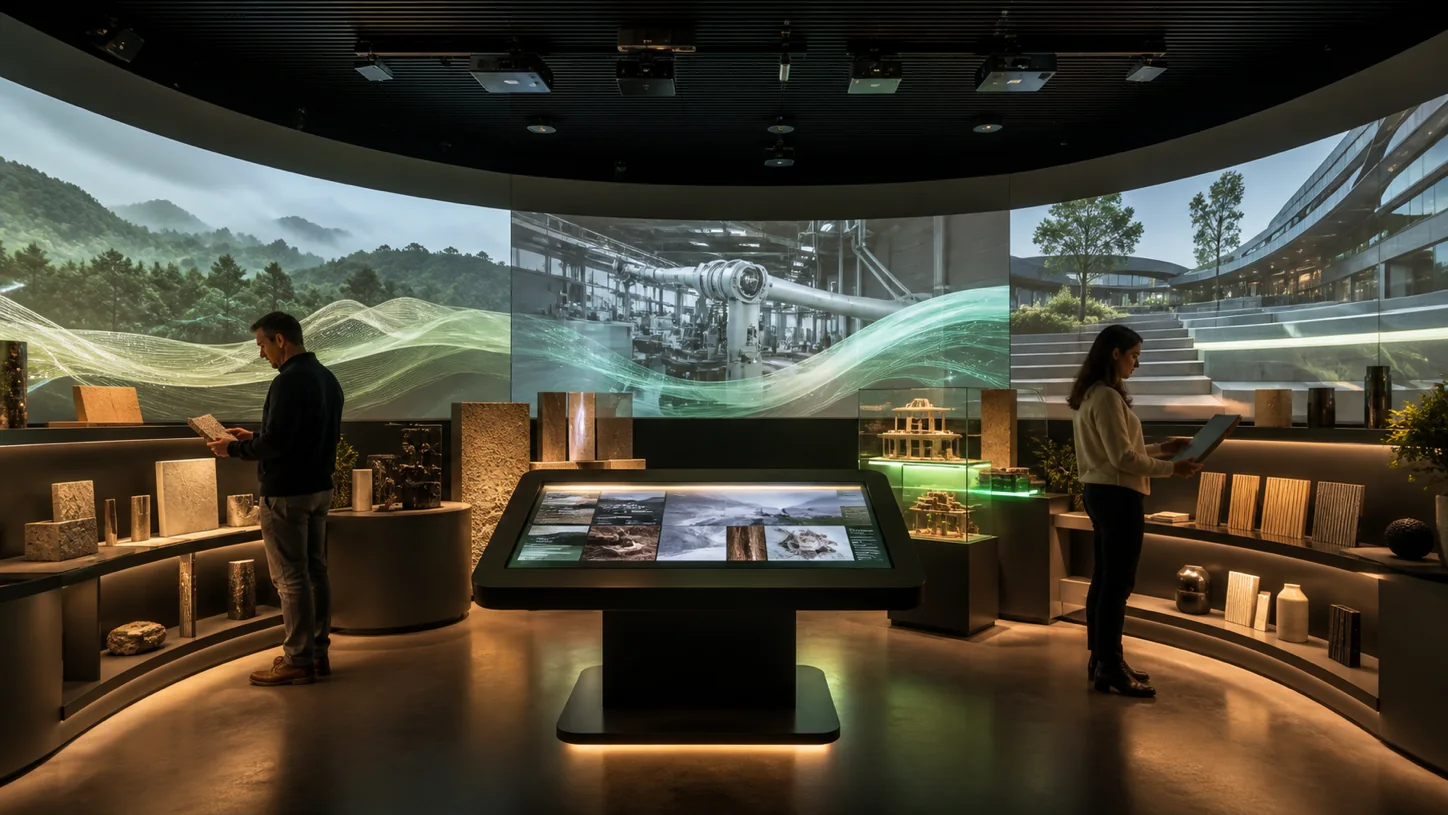
Concept visualisation
Story Room for hotels, resorts and venues
Let people experience the stay or event before they choose.
Destination, atmosphere, spaces and services become a physical, interactive journey. Guests and planners explore what makes the place distinctive and finish with a booking, upgrade, site inspection or proposal.
Story Room 180°: EUR 20,000–24,000 + VAT · Physical configurations start from EUR 26,000 + VAT. Scope is confirmed after the technical review.
Before and after
From a service list to a place that invites a choice.
Before, guests reconstruct the offer across reception, brochures and calls, while planners imagine an event in empty rooms. After, both follow a selected journey, see concrete possibilities and finish with the relevant action.
The place informs
Rooms, spa, dining, destination and services exist but are presented as separate elements.
The Story Room guides
Identity, atmosphere, spaces and offer become a sequence leading to a booking, site inspection or proposal.
Two economies
The same room guides guests and buyers towards different decisions.
The brand core remains consistent. Audience, depth and outcome change: services and activities for guests; spaces, flows and setups for planners and buyers.
Staying guest
Discovers destination, dining, spa, activities and services and carries them to their phone to book.
Wedding and social events
Sees the real sequence of the day, spaces in different layouts and the options shaping the quotation.
Meeting planners and companies
Compares capacities, flows, rooms, catering, AV and logistics, then requests a site inspection or proposal.
Visitor journey
Welcome → explore → scenario → choice → action.
Visitors do not browse a digital catalogue. Each chapter answers the next question: why this place, what can I experience, which configuration fits and how do I continue?
- 01
Welcome: identity, place and reason to stay
- 02
Explore: rooms, spaces, destination and services
- 03
Scenario: stay, wedding, meeting, retreat or launch
- 04
Choose: dining, spa, activities, setup and partners
- 05
Act: booking, upgrade, site inspection, brief or proposal
Commercial outcomes: Booked service · Site inspection and brief · Proposal and follow-up.
Configurations and investment
Four scopes. One complete system.
Every configuration includes Story Room, Activation and Measurement. The range depends on space, scenography and interaction; original content, building work, media and integrations are clearly scoped.
Story Room 180° Core
The complete 180° system with a first journey based on supplied materials.
EUR 20,000–24,000 + VAT
- Curved screen and dual projection
- Touch kiosk, sound and lighting
- Software and branded web app
- First journey from supplied materials
Essential physical Story Room
The Core with a selective physical fit-out and company objects integrated into the journey.
EUR 26,000–32,000 + VAT
- Everything in the 180° Core
- Essential spatial design
- Authentic materials and objects
- One main physical interaction
Complete physical Story Room
A complete brand experience with scenography, multiple objects and interactions designed together.
EUR 32,000–45,000 + VAT
- Everything in the 180° Core
- Scenography and textured surfaces
- Multiple objects and interactions
- Selected environmental effects
Bespoke Story Room
For geometries, visitor flows or integrations with specific requirements.
From EUR 45,000 + VAT
- Large machines or multiple rooms
- LED, domes and special projections
- Configurators and existing systems
- Original and multilingual productions
Want to check the space and equipment first? The technical and configuration sheet summarises requirements, inclusions and support.
The complete system
A permanent experience, use occasions and readable outcomes.
The room makes the offer desirable. Activation places it within arrival, concierge and commercial visits. Measurement links journeys, bookings or opportunities to the property’s economic data.
Story Room
Place, identity, services, spaces and scenarios become a permanent physical and interactive journey.
Activation
Pre-arrival, welcome, concierge, site inspections, open days and partners receive coherent invitations and touchpoints.
Measurement
Bookings, spend, RFPs, proposals, confirmations and margin can connect to PMS, POS, booking engine or CRM.
Guest: arrival → discovery → booking → spend → margin.
Planner: invitation → visit → proposal → confirmation → margin.
When to use it
One room. Four use programmes.
- 01
Arrival and first orientation
During check-in or waiting time, guests discover the place, services and activities available.
- 02
Concierge and guest programme
Short journeys for families, couples, business travellers or groups lead to relevant bookings.
- 03
Site inspection
Wedding planners, agencies and companies see scenarios, layouts and flows before a focused inspection.
- 04
Open day and partner preview
Agencies, DMCs, wedding planners and companies enter a programme of tracked visits.
Hospitality references
The best projects connect experience, service and decision.
Public references show four transferable principles: arrival can express the brand, destination can become an activity, spaces can be visualised before an event and immersion can become a bookable service.
Arrival immediately becomes experience and service.
Moxy integrates check-in into the bar and uses the lobby as an active social space, joining welcome, identity and offer.
Marriott · official source 02 · Six Senses Earth LabDestination and values become activities.
Earth Lab offers hands-on workshops and local initiatives, turning sustainability into experiences during the stay.
Six Senses · official source 03 · Kimpton Hotel EventiVisualisation supports sales and operations.
The public Cvent case documents 3D walkthroughs, diagrams and collaboration between sales, banqueting, AV and planners.
Cvent · public case study 04 · Plaza Sensory PoolImmersion becomes a bookable service.
The hotel combines imagery, sound, scent, water and rituals in an online-bookable spa offer.
Plaza Hotel · official sourceIndependent public references, cited for the design principles described.
Measurement and return
Return comes through bookings, events and margin.
Before the project, we define total cost and economic actions. We then separate the guest journey—services and spend—from the commercial journey—inspection, proposal and confirmation—through to contribution margin.
Actual use
Sessions, exposed guests or buyers, language, selected scenario and completion.
Guest actions
Dining, spa, activity, transfer, upgrade, retail and repeat booking.
Events pipeline
Site inspection, brief, RFP, proposal, win rate, room nights and confirmed value.
Value
Revenue, variable costs, commissions and margin linked to the agreed journey.
Data, research and measurement method
Measurement follows two economic paths. For guests it links exposure, selected service, booking, consumption and margin; for events and groups it links visit, brief, proposal, result, value and margin. Comprehension and recall improve the story, while payback uses recorded commercial actions.
Multisensory experience and memorability guide the design; they do not replace economic data. The report therefore separates journey-quality signals from observable bookings, proposals, confirmations and margin.
Frequently asked questions
What to know before assessing the space.
Which hospitality properties is it designed for?
Boutique hotels, resorts, heritage properties, spas, conference hotels and venues with a permanent place, recurring guests or commercial visits, and services or configurations worth understanding before a choice.
Does it need a dedicated room?
Not necessarily. It can fit into a lobby, lounge, pre-function area, separate reception or sales suite. The site visit checks area, light, acoustics, circulation and compatibility with operations and escape routes.
Does it replace the concierge or site inspection?
No. It prepares the conversation and makes recurring steps coherent. Concierge and sales teams explore needs and constraints; the site inspection validates the selected spaces in person.
How does it lead to bookings and proposals?
The finale can open a web app or QR with selected services, scenarios and preferences. Guests book dining, spa or activities; planners request an inspection, brief or proposal.
How is return measured?
For guests, exposure is linked to bookings, consumption and service or upgrade margin. For events and groups, the path covers inspections, briefs, proposals, win rate, value and margin.
Is it suitable for temporary events?
Story Room is a permanent installation used between events, especially for sales and welcome. Immersive productions for a single date require a different technical and operational scope.
How long does delivery take?
On average, three to six months from quotation to turnkey delivery, depending on the space, available content, building work, approvals, seasonality and integration.
Can content and languages be updated?
Yes. The interface and journey can update seasons, services, menus, treatments, activities, setups, partners and languages. Autonomy, training and support are defined in the offer.
How much does a hospitality Story Room cost?
The 180° Core costs EUR 20,000–24,000 + VAT. Physical configurations start at EUR 26,000–32,000 + VAT. Space, scenography, interaction, original content and integrations determine the final scope.
Initial guidance
Start with the audience and the decision you want to facilitate.
Share your name and email. We assess guests or buyers, frequency, services, space and commercial outcome before recommending a configuration.
Only name and email are required. You can add space, audience and objectives in the optional step.