Tourism, destinations and public administration
Help people understand the destination and continue beyond its main attraction.
We design visitor centres, routes and digital services that connect places, operators and content, work in several languages and make usage measurable.
From funding to service: objectives, content, technology, management and commissioning in one scope.
Where would you like to start?
A wall, a trail or a small environment: complete experiences in your space, with room to grow.
 First bounded intervention
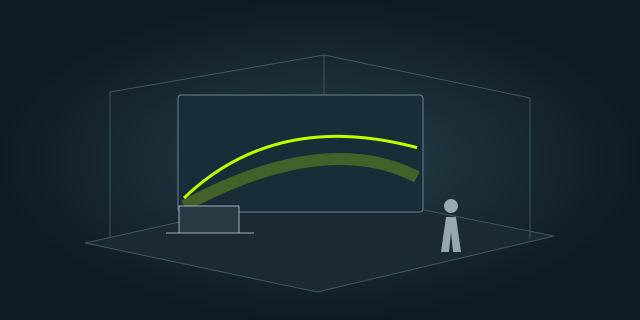
Story Wall
Interactive wall for product and place storytelling in showrooms, events and visitor spaces.
Your space. Hardware, content and integration by TUN.
Configuration and growth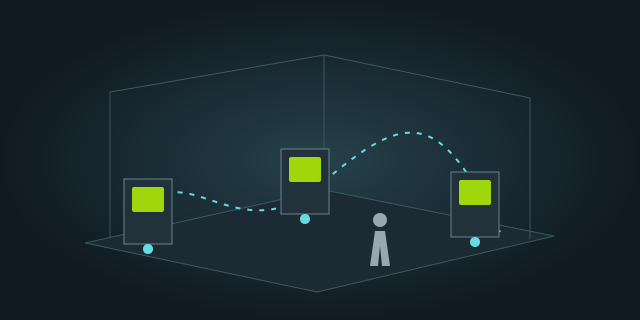 First bounded intervention
Story Trail
Interactive trail combining physical stops, digital content and on-site activities.
Your space. Hardware, content and integration by TUN.
Configuration and growth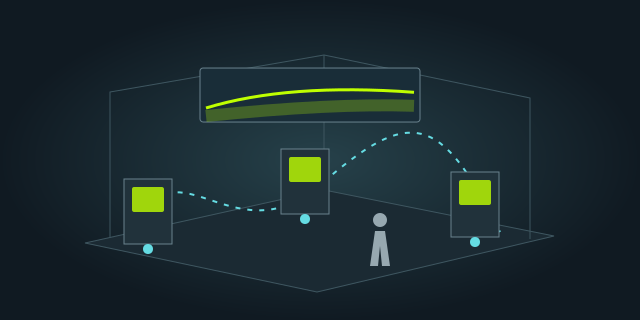 Compact configuration
Interactive Passport — Compact
Compact interactive journey with physical stops, a passport and a web app.
Your space. Hardware, content and integration by TUN.
Configuration and growth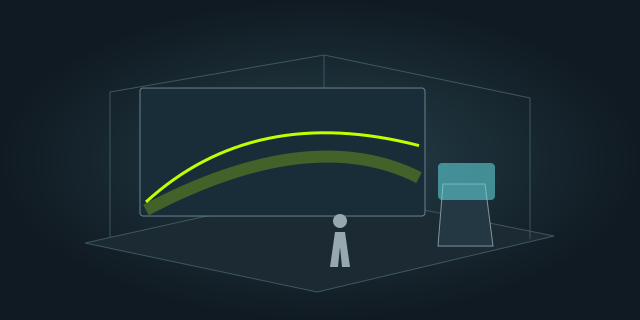 First bounded intervention
Interactive Info Point
Multimedia information point for discovery and orientation in visitor spaces, businesses and events.
Your space. Hardware, content and integration by TUN.
Configuration and growth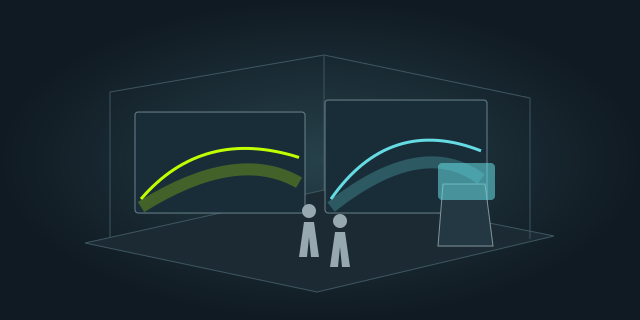 Compact configuration
Immersive Info Point
Visitor welcome point with immersive projection and interaction in an existing space.
Your space. Hardware, content and integration by TUN.
Configuration and growthOne main experience. More places to begin.
A point in a shop can lead to a visit at the main site. Each experience has value on its own.
In the shop or showroom
An object, a gesture, a short story. Discovery starts here.
At the main site
Visitors who wish to continue can access the main experience through a simple invitation or QR.
Back at the shop
A return visit can deepen product knowledge and continue the relationship.
The first point can stay active. A visitable main site and agreed management are required; replication, adaptation and maintenance are assessed for each location.
Destination needs
A destination experience works when access, content and management are connected.
Every intervention must be usable by the public and sustainable for those who update and operate it.
Connect places and operators
Attractions, services and local organisations communicate separately, so visitors cannot see a shared path.
Transformation
Maps, stages and content form a readable network with defined access and responsibilities.
Renew visitor centres and tourist offices
Spaces provide information but do not help people choose or explore the wider area.
Transformation
The space guides, presents alternatives and transfers the content needed to continue onto the visitor’s device.
Distribute visits
Flows remain concentrated in the best-known places and do not reach smaller areas or operators.
Transformation
Themed paths and contextual suggestions reveal more stages without imposing a single itinerary.
Work across languages and seasons
Content and services depend on opening hours, staff presence or uncoordinated translations.
Transformation
A common editorial system distributes accessible, multilingual content that can be updated throughout the year.
Measure usage
Attendance and content distribution do not explain which routes people actually use.
Transformation
Proportionate analytics events record access, progression and abandonment without mistaking them for commercial outcomes.
Turn funding into an executable project
The project states goals and purchases but may not define integrations, management, acceptance and continuity.
Transformation
Requirements, deliverables, responsibilities and acceptance criteria turn the idea into an executable plan.
Solutions for tourism and the public sector
Explore the paths for your project.
All solutions
Start with the problem, the audience and the operating context.
All solutionsFormats
Configurable project structures adapted to the content, place and audience.
FormatsOperating scope
The project includes what is needed to reach commissioning.
Space, content, software and management are coordinated with the organisations that will use and maintain the service.
Access point
A visitor centre, information point or installation makes the offer legible and starts the visit.
- Initial guidance
- Essential content
- Handover to mobile
Destination network
Places and operators share an editorial structure and updateable routes.
- Maps and stages
- Profiles and content
- Update roles
Executable project
Analysis, technical specification, production, integration and acceptance are handled as one flow.
- Verifiable requirements
- Explicit dependencies
- Delivery and training
Applied Apps & AI
Digital extends the service without separating it from the real destination.
Every component has a task, an information source and an operational owner.
Routes and maps
Web apps, maps and NFC connect physical points, records and contextual content.
- No account when possible
- Multilingual operation
- Off-season continuity
Controlled assistants
AI can help find information within approved sources, with declared limits and escalation to a person.
- Verified corpus
- Declared scope
- No automatic pricing decisions
Operational dashboards
Aggregated data helps teams understand access, paths and consulted content.
- Metrics defined first
- Declared data coverage and limits
- Export and accountability
Standards and references
Accessibility and digital destination management.
These references connect usable interfaces with European criteria for digital tourism services.
European Commission
European smart tourism criteria
The European Commission assesses destinations across accessibility, digitalisation, sustainability, cultural heritage and creativity.
European CommissionW3C Web Accessibility Initiative
Digital accessibility
W3C WAI resources guide content and applications that can also be used by people with disabilities.
W3C Web Accessibility InitiativeInitial assessment
Turn objectives and constraints into a verifiable scope.
Share the destination, audience, places, deadline and investment. The assessment prepares an initial direction without replacing technical and administrative analysis.