Hello, dear local administrator.
Do the squares of your city empty every summer while the nearby communities teem with life? Do you find yourself investing your last resources in yet another porchetta festival that barely attracts the usual local crowd?
If the answer is yes, you should know that the situation is more critical than you think.
Italy is the kingdom of local festivals, or “sagre” , with over 42,000 events every year . Sounds like a rich cultural tapestry, doesn't it? Yet, according to an analysis by FIPE (Italian Federation of Public Businesses) , an impressive 80% of these events have no real connection with the authenticity or promotion of local products. It is an inflation of events that has created a monster: the “free all of festivals.”
The problem explodes in August, with nearly 15,000 festivals crammed into a single month. It's as if every city in Italy had decided to shout the exact same thing at the exact same time. The result? A deafening noise where no one can be heard, a ruthless competition that dilutes local identity and drains municipal coffers.
In my years of experience in the world of immersive events, I have seen the frustration on the faces of hundreds of local administrators just like you. Declining budgets, declining participation, and young people? They are already elsewhere.
But what if I told you that someone has found a way to not only survive, but dominate this landscape? Today I'll tell you a story that could forever change the way you think about land marketing.
The case study that killed the local festival: Annone Brianza and the Miracle without a name
We are talking about Annone Brianza , a small town of around 2,300 souls in the province of Lecco. Until recently, it was just a name you'd read absentmindedly on a highway sign. Today? It is one of the most popular destinations for young people in Italy.
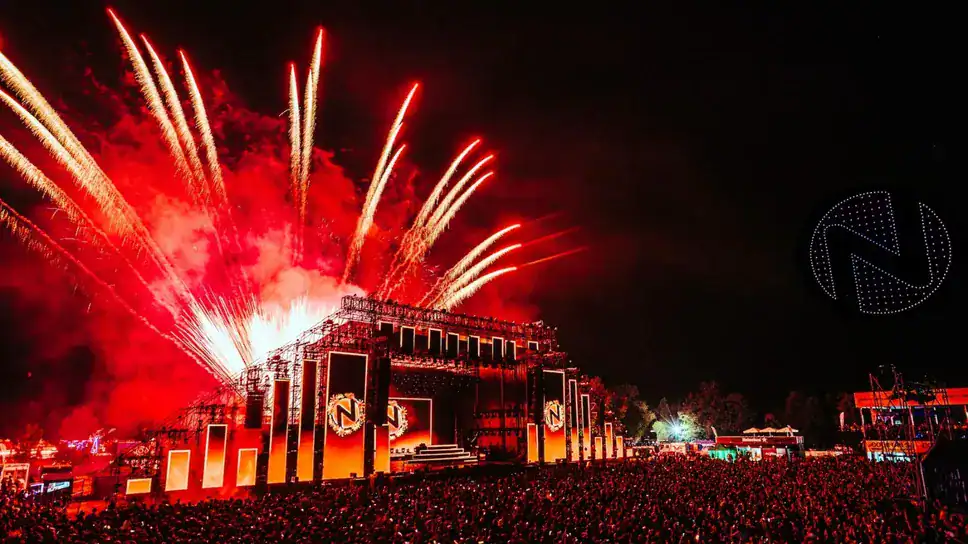
The spark was lit by a vision and a strategic partnership: that between a far-sighted local administration and Alberto Fumagalli, CEO and founder of the Nameless Festival . The goal was not to organize “just another concert”, but to create a total experience, an event that would rewrite the rules of the game.
The numbers speak for themselves, and are almost unbelievable:
- Exponential Growth: From 6,000 participants in 2013 to over 100,000 in recent editions.
- An Insane Growth Rate: An average annual progression of 50.87% . In the world of local events, this is not a success. It's a miracle.
Of course, the path was not linear. The festival, born in Lecco, moved to Barzio and, finally, from 2022, found its permanent home in the vast "La Poncia" area, between Annone di Brianza, Molteno and Bosisio Parini. Each move marked an evolution, a refinement of the formula.
But the real masterpiece lies in the economic and tourist impact:
- A Tourist Magnet: 85% of participants come from outside the region. Annone Brianza, the once anonymous city, has become a magnet for youth tourism, even entering the rankings of trending destinations on platforms such as Airbnb .
- A Boom for the Region: Tourism in the province of Lecco has exploded, with an increase of +25.8% in presences in 2023 alone compared to the previous year. Accommodation facilities went from just over 3,300 to almost 4,000 in just one year to meet demand.
- Stellar Economic Return: The estimated economic impact of the festival? Around 10 million euros . In three days . That's more than the annual budget of many similarly sized municipalities.
How did they do it? Simple: they stopped playing small. Instead of offering the usual cover band, they focused on world-renowned artists such as Armin van Buuren, The Chainsmokers and Martin Garrix , raising their offering to an international level, far beyond any possible local competition.
From Case Study to Strategic Principle: The Lesson You Need to Learn
I know what you're thinking: "Of course, it's easy with a giant like the Nameless Festival. I have the patron saint's day and the tortellino festival. What can I do?"
This is where you are wrong. The secret is not in the budget or the type of event. It's in the mindset.
Let me tell you a personal story. Years ago, I worked with a small town in the Apennines, proud of its “Chestnut Festival,” which had been held for 30 years. Average participation: 500 people, almost all local. Analyzing the situation, we discovered that within a 50 km radius there were 12 other chestnut festivals , all on the same weekend.
The instinctive reaction would have been to "do it better": tastier chestnuts, lower prices. But it wouldn't have worked. The problem wasn't quality. The problem was that we were playing the exact same boring game as 12 other cities.
The Nameless Festival taught us a revolutionary principle: you don't have to compete better, you have to stop competing altogether. You need to create a new event category in which you are the only player.
In the business world, this is called Blue Ocean Strategy . Instead of fighting to the death with sharks in a “red ocean” of competition, you create a “blue ocean” of your own, an uncontested market space where you can swim freely.
How does this apply to local events? The Nameless strategy is based on three pillars that anyone can adapt:
- Radical Uniqueness of the Offer: Instead of improving existing formats (the local festival, the village festival), they created a new and hybrid experience. They didn't ask, “How can we make a better festival?” They asked, “What is completely missing in this area that no one else offers?”
- Scale and Ambition: They thought big from day one. Not an event for Annone, but an event in Annone that would have attracted all of Italy. Ambition is not about money; it's a question of vision.
- Continuous Innovation: Each edition is different. New stages, breathtaking scenography, emerging technologies. The event is not a static relic; it is a living organism that evolves and surprises, keeping interest skyrocketing.
Immersive Technology: Your Secret Weapon to Create a “Blue Ocean”
And this is where technology becomes your greatest ally. But be careful: I'm not talking about renting an LED screen to put behind the city band. I'm talking about using technology to create experiences that people can't find elsewhere.
Think fulldome projections inside geodesic domes . These aren't just tents. They are portals to other worlds. Imagine your square with one of these 25 meter domes. Inside, 200 people at a time are not watching a show: they are immersed in a 360° experience that surrounds them.
One moment I am under the celestial vault of your castle; the next moment, they're sailing on a stormy ocean or floating in deep space, all while the story of your region is told in a way never seen before.
Geodesic domes aren't just for show. I am:
- Ultra-resistant: they withstand winds over 160 km/h and heavy snow loads.
- Flexible: they can be installed anywhere.
- Customizable: and can accommodate complex audio, lighting and video systems.
But the technical specifications are not the point. The point is the “WOW factor” . That moment of pure wonder that breaks the monotony, captures attention and becomes an indelible memory.
And what happens when you create a memorable experience? You generate the most powerful marketing in the world: spontaneous viral word of mouth. People don't just take a forced selfie. They share their genuine amazement. Every visitor becomes an enthusiastic ambassador for your city.
In addition to the fulldome, the technologies at your disposal are endless:
- Virtual and Augmented Reality to bring historical characters to life in the streets of your village.
- Projection Mapping to transform the facade of your town hall or church into a spectacular and dynamic screen.
- Artificial Intelligence to create personalized experiences.
- Contactless technologies and digital payments for a fluid and modern user experience.
Does it sound like science fiction? Let me give you another concrete example. We worked with a municipality that had been organizing a medieval historical reenactment for 50 years. Attendance: 2,000 people, mostly elderly. We introduced projection mapping on the castle walls and an Augmented Reality app that made soldiers “walk” through the crowd.
The result? 15,000 participants, 60% of whom are under 35, and national media coverage. The municipality has become a beacon, an example of how tradition and innovation can create something explosive.
What YOU CAN do, immediately: 3 concrete actions
Enough theory. Let's translate all this into actions you can start tomorrow morning .
- Map your “Blue Ocean”
- Practical Action: Organize a workshop with twenty- and thirty-year-olds in your city and ask them: "What forces you to go elsewhere on weekends? What is missing here?" Analyze their answers. Your blue ocean is hidden in there. Don't try to make a better wine festival. Try creating the only “historic escape room in the castle” or the first “silent disco festival in the park.”
- Build your Innovation “Dream Team”.
- Practical Action: You don't have to buy the technology; you have to find the right partners. Launch a call for “digital art residencies”: invite artists and designers to use your city as a canvas for their installations. Contact local universities and tech companies. They are often eager to support real projects.
- Measure what REALLY matters
- Practical Action: Stop counting only tickets sold. Implement modern metrics. Measure dwell time, visitor return rate, revenue growth for local businesses, and mentions across media and social channels. Create a public dashboard with this data. Transparency builds trust and consensus.
Bottom line: Your only real competition is boredom
The success of the Nameless Festival is not the story of a music festival. It is proof that an event, if conceived with courage, can become the most powerful territorial marketing tool that exists.
In an era where young people seem lost in their smartphone screens, the winner is those who can offer real experiences, enhanced by technology.
Your city is not competing with the neighboring city. It's competing with Netflix, with Instagram, with PlayStation. And the only way to win is to offer something no screen can ever provide: shared wonder, genuine emotion, a memory that lasts a lifetime.
The future of local events isn't about doing what our grandparents did, only better. It's about creating experiences that our grandparents could never even dream of.
The question, dear fellow leader, is no longer whether your city can afford to innovate.
The question is: can you really afford not to?