As you may have noticed, I'm not a fan of rigid editorial calendars. I prefer quality over quantity and don't like the idea of publishing a superficial piece just to meet a deadline. This article required days of reflection because it touches a raw nerve for many of you, public administrators and destination managers who I meet every day. The question, whispered with a mixture of hope and frustration, is always the same: "Dario, how can we compete with the big cities, given the budgets we have?"
The answer I usually give is surprising because it doesn't involve grants, funds or million-euro advertising campaigns. It's about something much more powerful. It's about people.
The problem
Dear Mayor, dear Councillor, dear manager, let's be honest with each other. How many times have you looked at the annual budget of your municipality, trying to make ends meet for tourism promotion ? It's an unequal fight, I know. But the question that haunts you, the one I hear in every meeting and read between the lines of every email, is always the same: how to promote a city without a budget?
This is the challenge that unites small and medium-sized cities across Europe. A question that speaks of frustration, of unexpressed potential. The squares of our wonderful and historic cities fall silent at sunset. The events, organized with immense passion and effort, struggle to create an echo beyond regional borders. And in the end, when it comes to justifying expenses, you come up against the harsh reality of numbers, ROI and political consensus.
Many believe that the answer to “how to promote a city without a budget” is impossible to find, that it is condemned to remain in the shadow of the big destinations. But they are wrong. The solution is not to try to compete on their terms, but to completely change the rules of the game. There is a strategy, a methodology that I call Zero Cost Marketing , which transforms your greatest weakness – your limited budget – into your greatest strength. And to understand this, we must start from an incredible success story.
The case study
Let me take you to a place that, until a few years ago, was known mainly by nature lovers and a few residents. We are talking about the area between Annone di Brianza and Bosisio Parini in Italy. A beautiful place, sure, but not exactly at the top of tourist destinations. Today, that place is on the lips of hundreds of thousands of young people and beyond, thanks to an event that has rewritten the rules of territorial marketing: the Nameless Festival .
The story of Nameless is a master lesson for any public administrator. In 2013, its first edition attracted around 9,000 people . A good result, but nothing that foreshadowed what was to come. Year after year, the event has grown exponentially, almost virally. The numbers speak for themselves: by 2025, the festival surpassed 100,000 attendees in four days, with an annual growth rate hitting 50% . We are talking about a true peaceful invasion, a pilgrimage that transformed a quiet area into an epicenter of energy and visibility.
What was the situation before? An area with latent tourism potential, linked to a traditional local economy. And after? An internationally renowned event that generates a multi-million dollar economic impact , creates jobs (we are talking about over 100 new direct and indirect jobs linked to the event) and captures the attention of the national media. But the crucial question is: how did they do it? Have they spent tens of millions on advertising? Have they plastered the cities with posters? None of this.
The secret to Nameless's success lies not in its marketing budget, but in the obsessive quality of the experience it offers. The organizers understood a fundamental principle: in a hyperconnected world, experience is the means. The participants, completely amazed by the quality of the music, the impeccable organization and, above all, the spectacular sets and installations, became the first and most effective promoters of the event . Every smartphone pointed at the stage, every video posted on Instagram, every story on TikTok was just another piece of a colossal and free advertising campaign. This phenomenon is what I call the sharing “wow” effect.
From the case study to the strategic principle
Here we get to the heart of the matter, the lesson that every administrator can and must learn from the Nameless case. Success did not come by marginally improving the existing model, but by completely changing the rules of the game. The universal strategic lesson is this: the best marketing is not what you pay, but what you earn through the irrepressible enthusiasm of your audience .
This is the first, real answer to the question “how to promote a city without a budget.” Stop thinking in terms of “ad space purchased” and start thinking in terms of “memorable moments created.” The strategic goal for a city with limited resources is not to buy attention, but to deserve it. And to deserve it, you have to offer something that goes beyond expectations, something that generates an emotional reaction so strong that it turns into a spontaneous story. In the book “Immersive Events,” we define this approach as designing experiences that are “ Instagrammable by design .” It's not about adding a cute photo corner. It's about designing the entire experience - be it an event, a museum tour or the redevelopment of a square - to be intrinsically spectacular, shareable and worthy of being told.
This approach shifts the investment: from the marketing budget to the production budget. Instead of giving €50,000 to a media agency to plan a traditional advertising campaign (whose effect, let's face it, is often uncertain and short-lived), invest the same €50,000 to create a unique experience in your territory. An experience that, if well designed, will generate spontaneous media value through digital word of mouth that far exceeds the initial investment.
This is a complete paradigm shift. The new strategic question is no longer "How can we tell the world about our city?", but becomes: " What can we create in our city that is so incredible, that the world can't stop talking about it? ". The answer to this question is the key to competing and winning. And the good news is that today there are accessible technologies that make this strategy a concrete reality for any municipality.
Technology as an enabler
At this point, a natural question arises: "Okay Dario, the principle is fascinating. But how, in practical terms, is this 'wow' effect created? How is wonder produced?". This is where technology ceases to be a cold tool and becomes the most powerful ally for anyone wondering how to promote a city without a budget . I'm not talking about technology as an end in itself, but about solutions that serve a specific purpose: to amplify emotions and make an experience so unforgettable that it promotes itself.
This type of transformation is made possible by a specific category of tools: immersive technologies . These are technologies that do not simply show something to the viewer; they envelop him, immerse him and make him an integral part of the narrative. And they are natural magnets for creating what is technically known as User-Generated Content (UGC) . Today, 92% of consumers trust other users' recommendations more than any traditional advertising. Turning visitors into content creators is a strategic imperative.
Let's look at the key technologies:
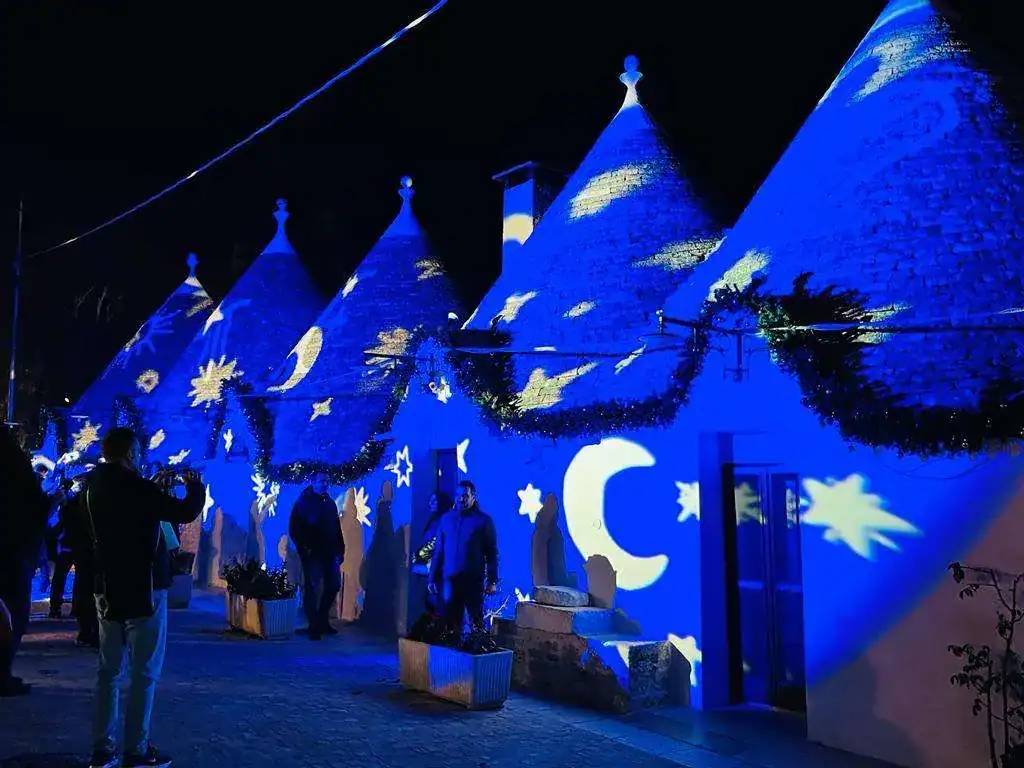
- Architectural Video Mapping: Imagine the facade of your town hall, the one that citizens see every day. Now, imagine it coming to life, telling the story of the city, transforming into a show of lights and colours. This is video mapping. Its power is twofold. First, it is completely non-invasive : not a single stone is touched, it is made of pure light. Second, turn the familiar into magic. A building that people took for granted suddenly becomes the star of an incredible show. The instinctive reaction? Take out your smartphone and share. The Alberobello Light Festival demonstrated a direct link between this technology and a massive increase in tourist arrivals. It is, by definition, Instagrammable .
- Immersive Projections in Geodesic Domes (Fulldome): If video mapping transforms the outside, immersive geodesic domes, like our THOLUS DOME , create a world inside. The viewer is surrounded by a 360 degree projection. He is no longer in front of a screen; it's inside the screen. These structures are incredibly versatile “containers” for experiences. Today they can host an astronomy lesson, tomorrow a digital art installation, and the next day an immersive concert. For a municipality, it means having a strategic asset that continuously generates new flows of visitors and, consequently, new digital word of mouth.
- Interactive Installations: The last piece is direct involvement. Works of art that react to the presence of people: floors that light up, walls that change color at your touch. Here, the visitor becomes a co-creator of the work. The experience becomes unique, personal and unrepeatable, as demonstrated by the work of world-renowned artistic collectives such as teamLab . And what do we do when we experience something unique? We share it. This type of technology creates a strong bond between the person and the place, generating spontaneous memories and content.
Investing in these technologies is not an expense, but a strategic investment
into a perpetual marketing machine. The data confirms it: 77% of managers who invested in immersive experiences found a positive ROI. Our internal analysis at the usual neXt is even clearer: compared to a paltry 23% of traditional events that can demonstrate a clear return on investment, the figure rises to an incredible 95% for the immersive events we design. Why? Because the public's enthusiasm is not a "nice to have". It is a measurable economic asset.
Practical advice: the first steps to promote a city without a budget
All very nice, Dario. But what do I say at the Monday morning meeting? Here are 3 concrete actions to immediately start putting this methodology into practice.
- Review the budget as an investment in “Wonder.” Instead of spreading your budget across a thousand small, low-yield initiatives (flyers, trade shows, online ads), make a bold decision. Focus a significant portion of those resources on creating a unique, spectacular, unforgettable “wow” experience in an iconic location in your city. It is not an expense; it's an investment in a self-sustaining marketing asset.
- Identify your “blank canvases.” Look at your city with new eyes. That anonymous facade of a historic building? It's a perfect canvas for video mapping. The square that empties in the evening? It is the ideal location for a temporary immersive dome. Conduct a “wonder audit”: map underutilized locations with the highest scenic potential and turn a problem into an opportunity.
- Measure the echo, not just the inputs. Stop measuring success by ticket sales alone. The true ROI of Zero Cost Marketing is measured differently. Your new Key Performance Indicators (KPIs) must be: the number of contents (photos/videos) published on social media with the event hashtag or city tag; the Interaction Rate (likes, comments, shares); and Organic Reach , i.e. how many people were reached not by your advertising, but by the posts of your visitors' friends.
The vision
For decades, a story has been told. A story where you need vast capital to compete, and the small ones are bound to lose. It was a convenient narrative for those selling advertising space. Today, that narrative is dead. The 21st century does not belong to those who shout the loudest, but to those who know how to create the most authentic emotions.
The question we started with was "how to promote a city without a budget?". I hope it is clear that the answer is not "you can't". The answer is: changing the rules, investing in experiences instead of advertising, transforming every single visitor into the most powerful and passionate ambassador for your future.
The real magic is not in the light projected on a wall. It is in the enlightened eyes of a visitor who sees something he did not expect, in his irresistible impulse to share that amazement with the world. And today, you have the power to light up those eyes.