Immersiveness in Italy represents a cultural phenomenon of extraordinary importance that has its roots in history and projects towards the future with bold innovation.
From the centuries-old heritage of Apulian illuminations to the most sophisticated video mapping technologies that redesign historical monuments, our country has been able to transform its cultural heritage into a living laboratory of multisensory experiences. This journey through the different forms of Italian cultural immersion – from popular traditions to contemporary art festivals, from digital planetariums to immersive exhibitions – reveals how Italy is redefining the relationship between technology, art and collective participation. The information and data presented in this in-depth analysis are taken from the book “Immersive Events” by Dario Riccio , which offers a complete analysis of this constantly evolving sector.
From the glittering baroque of the Apulian illuminations to the video mapping shows on historical monuments: immersion in Italy transforms spaces and places into extraordinary multisensory experiences.
Italy is not only the cradle of the Renaissance and guardian of an unparalleled artistic heritage. It is also a living laboratory where tradition and technological innovation come together. From North to South, our country redefines the way we experience art, culture and public spaces. Light installations, digital projections and multisensory environments transform each visitor into the protagonist of extraordinary emotional narratives.
Before terms like "immersive installation" or "multisensory experience" entered the common vocabulary, Puglia had already invented its form of total art: the illuminations. These ephemeral architectures of light transform squares and streets into glittering cathedrals during the patronal festivals. They represent perhaps the oldest and most authentic example of an immersive environment in Italy.
The Puglia Illuminations: When Immersion in Italy Was Already Tradition
The origins of this art are lost in the 16th century. Simple oil lamps were arranged on wooden structures that recalled the elaborate forms of Baroque architecture. Technological evolution has accompanied this tradition: from oil to candles, from terracotta lamps to electricity. Today, modern LEDs allow chromatic and dynamic controls that were unthinkable just a few decades ago.
Scorrano, in the heart of Salento, is today considered the "world capital of lighting". Every July, during the feast of Santa Domenica, the small village is transformed into a monumental spectacle. The event attracts visitors from all over the world. The 2024 edition offered a perfect example of how tradition and innovation can coexist. From the classic "curtains of lights" to luminous sculptures that reproduce famous monuments such as the Eiffel Tower and the Taj Mahal.
The most extraordinary aspect of modern illuminations is their ability to create a complete multi-sensory experience. The “musical lights” transform the squares into vibrant stages. Light, sound and collective participation come together in a single moment of shared celebration. It is no coincidence that this tradition has been proposed as a UNESCO Intangible Cultural Heritage. It continues to conquer international markets.
Contemporary Light Festivals: The Art that Illuminates Cities
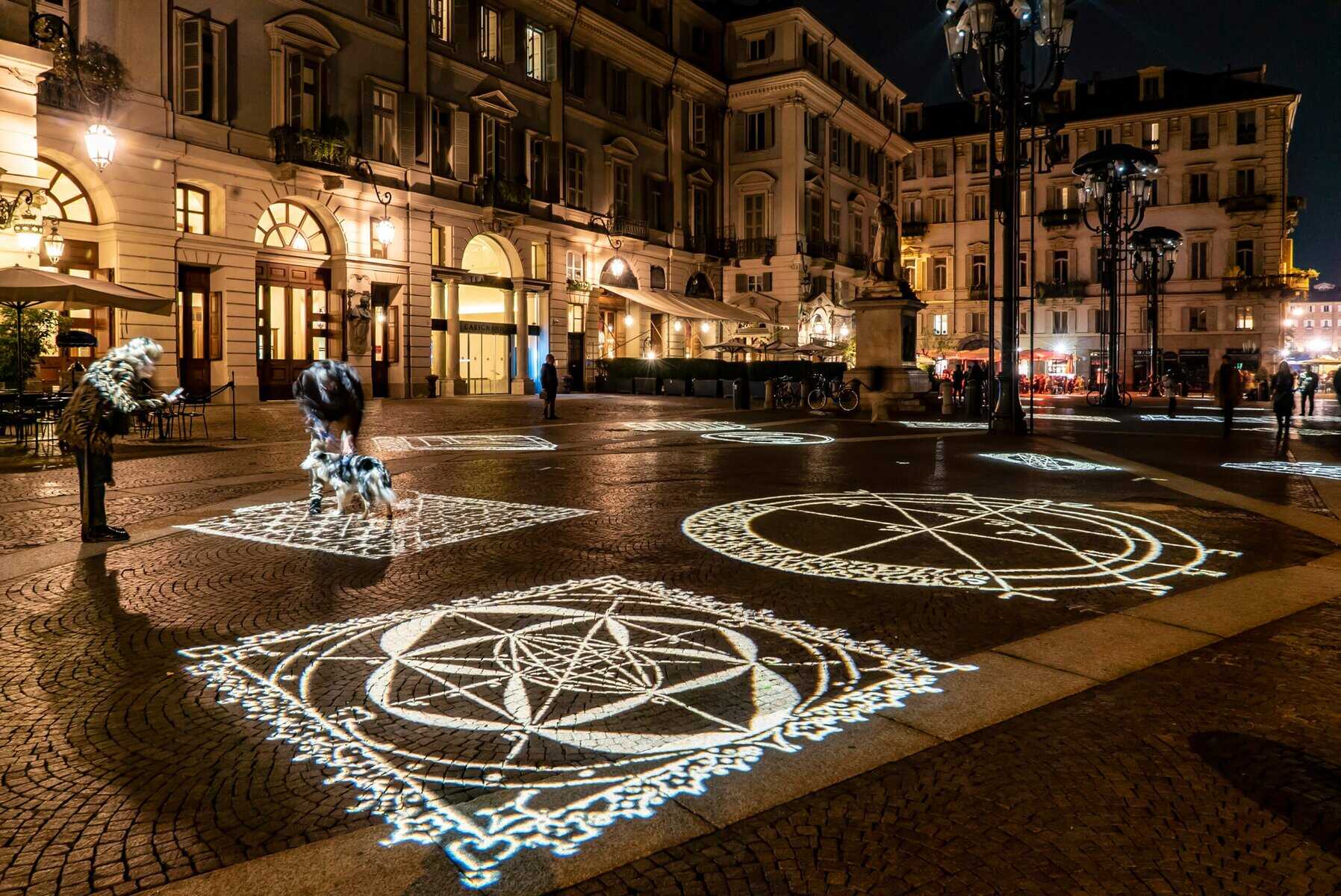
If the illuminations represent the traditional root, contemporary light festivals are the most refined artistic evolution. Luci d'Artista of Turin, born in 1998, has transformed the Piedmontese capital into "an open-air museum". It features permanent installations by international artists such as Daniel Buren, Rebecca Horn and Michelangelo Pistoletto.
The 27th edition of the festival took place from 25 October 2024 to 2 February 2025. It confirmed the longevity of this event which has continuously reinvented itself. It has expanded beyond the Christmas season to include special events during the summer solstice.
In Florence, F-Light – the Festival of Lights illuminated the main monuments of the historic center. It uses light installations and video mapping, placing already extraordinary architectural elements under a new perspective. The 2024/2025 edition has chosen as its central theme "the celebration of nature and the transformative power of the seasons". It demonstrates how these events can go beyond pure entertainment to convey messages of social and environmental relevance.
Video Mapping: Painting with History with Light
Video mapping represents perhaps the most spectacular form of valorization of historical heritage through immersion in Italy. Rome, with its incomparable monumental heritage, has become an ideal laboratory for this technique. It allows you to "paint" architectural surfaces with light.
A masterly example is the intervention carried out in 2019 on the Domus Transitoria on the Palatine. It was the first residence of Emperor Nero. Through perfectly aligned projections, technology has virtually reconstructed the missing parts of a precious fresco. He revived the original colors and offered a clear reading of the work in its former glory.
On an even more impressive scale, the “Sidera Aurea” project in Padua represented the largest immersive projection mapping. It has never been built in a UNESCO World Heritage site. The 20-minute show projected images both onto the wooden vault and onto the frescoed walls. He created a visual and audio “time machine” to tell the story of the building. Through 333 virtual windows that overlooked the artistic vision.
Digital Planetariums: Immersive Journeys among the Stars
Planetariums represent one of the most consolidated examples of immersion in Italy. They offer many permanent spaces dedicated to immersive educational experiences. The Milan Planetarium, active since 1930 and considered the most important in Italy, welcomes around 100,000 visitors a year. It demonstrates the public's ongoing interest in immersive science experiences.
Infinito, the Digital Planetarium of Turin, represents the technological evolution of this tradition. It uses the Digistar 6 system, among the most advanced in the world. Integrates 9 computers to simulate increasingly realistic space travel. Technology allows not only to observe the starry sky. It also allows you to "fly over the Sun and planets, follow satellites and space probes, get closer to star clusters and distant galaxies".
Particularly interesting is the Planetarium of the Balì Museum, inaugurated in 2020. With its 8 meter dome it demonstrates how smaller structures can offer equally engaging experiences. It is told as "a nocturnal dream suspended between reality and fantasy".
Immersive Art Exhibitions: Literally Entering the Painting
A particularly popular phenomenon is that of immersive art exhibitions dedicated to the great masters of painting. These experiences transform two-dimensional works into enveloping environments. Visitors can literally "enter" the paintings.
The Cathedral of the Image of Florence, born in 2015 from the conversion of the deconsecrated church of Santo Stefano al Ponte. It is the first permanent space in Italy dedicated to immersive digital art. “Inside Matisse – Immersive Exhibition” transformed the space into a 360° multimedia environment. For 35 minutes he is flooded with images, lights, colors and music.
In Rome, the Next Museum hosted “Monet and the Impressionists – Digital experience”. It is structured around the four seasons with a path that focuses on the technical aspects of Impressionism. The soundtrack inspired by Vivaldi's “Four Seasons” completed the multi-sensory experience.
Particularly significant was the exhibition “Van Gogh – Colors and solitude” in Racalmuto, Leonardo Sciascia's Sicilian town. This event demonstrated how immersive technologies can contribute to cultural democratization. They bring world-class art to local and peripheral contexts.
New Frontiers of Immersion in Italy: From Entertainment to Wellbeing
Immersion in Italy is experimenting with innovative forms that range from entertainment to science, from gastronomy to psychophysical well-being.
“Welcome to Rome” uses projections and interactive exhibits to tell 2700 years of history. “Nuragica” in Cagliari offers a multi-sensory journey into the Sardinian Nuragic civilization. The MUSE of Trento with “Food Sound” explores the link between sound and the perception of taste.
In the restaurant sector, “Le Petit Chef” in Como uses 3D Projection Mapping. Project the animated story of a miniature chef directly onto the tables. It combines haute cuisine and visual entertainment.
Therapeutic applications are also emerging: recent studies highlight how immersive art helps reduce stress and stimulates creativity. It offers immersive, multi-sensory experiences with significant psychological benefits.
A Counterpoint to Digital Fragmentation
In 2020 only 7% of Italian museums offered experiences with augmented reality technologies. 54% of cultural institutions said they intend to implement these technologies in the future. These numbers signal a growing interest that goes beyond simple technological innovation.
Immersive experiences in fact represent an important counterpoint to contemporary digital fragmentation. While technology increasingly tends to isolate people in individual experiences, these events bring back the collective and social dimension. They place it at the center of the cultural experience.
Conclusions: Immersion in Italy between Memory and Future
The Italian panorama of immersive experiences reveals an extraordinary ability to combine respect for tradition and openness to innovation. From Scorrano's illuminations to projections on the Colosseum, from digital planetariums to immersive exhibitions, Italy demonstrates that it is possible to enhance cultural heritage. It uses contemporary languages without betraying its essence.
The geographical distribution of these experiences is particularly significant: from large metropolises to small villages. Immersive technologies prove flexible and accessible, facilitating broader and more democratic cultural participation.
Italy is thus in a privileged position to continue exploring the potential of immersive events. As bridges between past and future, tradition and technology, individual and community. In an era of increasing virtualization, these projects are a testament to our country's unique capability. They transform physical places into theaters of shared emotions, where technology puts itself at the service of humanity. They create new ways of poetically inhabiting the world.
“Immersive Events: Your Guide to Transforming the Human Experience”
The panorama outlined confirms that immersion in Italy is not simply a technological trend. It represents a new form of cultural expression that reflects the profound identity of the country. From the intimacy of local traditions to the grandeur of metropolitan installations, from educational to therapeutic applications. An Italian model of immersion emerges characterized by the unique ability to bring together history and innovation, individual and community, local and global.
This ecosystem of immersive experiences testifies to the vitality of a country that knows how to continually reinvent its forms of expression. It does not lose its authenticity. At a historical moment in which technology risks fragmenting the human experience, Italy demonstrates that it is possible to use the most advanced digital tools. It rebuilds community ties and offers new keys to understanding cultural heritage.
For a complete in-depth analysis of all aspects of the Italian immersive sector, please refer to the volume "Immersive Events" by Dario Riccio , the source of all the information and analysis presented in this article.