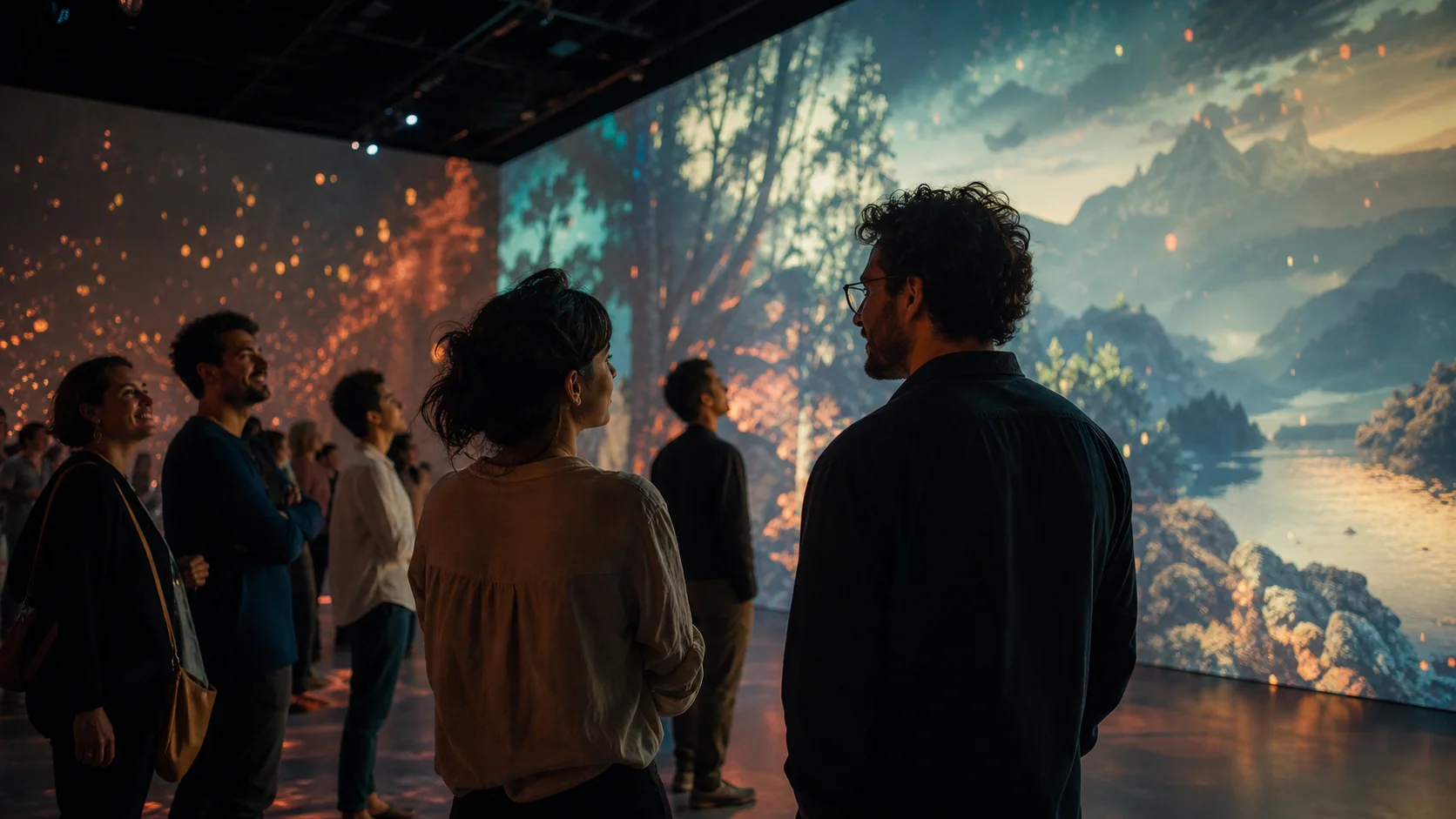
For years, immersive technology has been framed through a precise image: one person, one headset and a digital world set apart from everything around them. The more useful direction may be almost the opposite: technology integrated into real places, enabling people to see, listen, choose and respond together.
Shared immersive experiences are physical or phygital environments in which several people take part in the same scene at the same time, while remaining able to see, communicate with and influence one another. Their value is not spectacle alone. It depends on physical presence, shared attention and participation.
What makes an immersive experience genuinely shared?
Immersive, interactive and shared are not synonyms. Immersion focuses attention in a space; interactivity gives an action a consequence; sharing exists when participants are aware of one another and their behaviour becomes part of the experience. Designing that relationship requires more than technology.
An experience is immersive when it changes the perception of a space through image, sound, light, scenography or other stimuli. It is interactive when people’s actions change a scene, reveal content, alter a route or activate an object.
It becomes truly shared when several people live the same moment, know that the others are present and can influence one another. A room in which twenty people watch a film is collective, but not necessarily social. An environment in which those people must compare views, choose, collaborate or react together creates a different condition.
Immersion is a condition. Connection is an outcome that must be designed.
Projection quality, audio and graphics are not enough. What matters is what the audience is invited to do with them: observe a detail together, distribute information, make a joint decision, help another person or make a reaction visible.
Why do we need experiences that are lived together?
More content and communication channels do not automatically create better relationships. The question is not whether to reject digital tools, but how to use them to create more opportunities for presence, action and connection in the real world. Shared experiences can contribute to those opportunities without claiming effects they cannot demonstrate.
In its 2025 global report, the World Health Organization Commission on Social Connection estimated that roughly one person in six worldwide experiences loneliness. The WHO identifies several contributors, including economic and health conditions, personal changes, discrimination, inadequate community infrastructure, public policy and patterns of digital technology use. It would therefore be inaccurate to attribute the issue only to smartphones or social media.
A 2026 UK Biobank observational study, based on 236,879 people followed through 2022, found associations between loneliness, social isolation, multiple health conditions and mortality. It does not establish one simple causal chain, but it confirms that social connection is a meaningful variable in people’s lives.
Virtual interaction can support real relationships, particularly when distance makes meeting difficult. However, a 2024 study in Computers in Human Behavior Reports found positive associations across several forms of online communication, while face-to-face contact showed more consistent benefits in both the short and longer term.
Co-presence is not simply a sharper video call
Physical presence includes posture, distance, gaze direction, movement and reciprocity: elements that a good video connection does not reproduce automatically. The difference is not only image quality, but the awareness of sharing the same space with another person.
An experimental study in Imaging Neuroscience compared face-to-face visual interaction with live webcam-mediated conditions. Across 14 pairs, in-person interaction showed longer face-looking times, larger average pupil dilation and differences in neural activity and synchronisation. The sample is small and the setting controlled, but the result is a useful reminder not to reduce co-presence to screen resolution.
A common stimulus can align attention and arousal
Attending the same event does not automatically create friendship or belonging, but it can align attention and emotional arousal over time. For anyone designing a space, that means creating scenes that several people can read at once, with a rhythm that also leaves room for their reactions.
In 2024, a Scientific Reports study observed the physiological responses of 695 people during eleven public classical-music concerts. Researchers recorded synchrony in heart rate, heart-rate variability, respiration and skin conductance. The effects were neither identical for everyone nor present in every measure, yet they show that a jointly experienced event can produce temporally aligned responses.
A 2025 systematic review covering 59 studies and more than 17,900 participants in live-music events organises its findings around opportunities for connection, shared values, temporary communities and belonging. The authors also note limits in sample representativeness. These principles should therefore become hypotheses to test in each project, not automatic promises.
Reciprocity can matter more than presence alone
An audience stops being a passive mass when it is recognised, addressed or asked to make something happen. A choice that changes the route, a gesture that activates a scene or a complementary role makes the experience depend on participants’ presence, rather than on their attention alone.
A 2025 iScience study using mobile EEG found greater synchrony between audience members when performers interacted directly with them during dance performances. Follow-up experiments found higher engagement and synchrony in a live, shared condition than in individual viewing of a recording.
A study of paired exercises, online and in person, also observed increased perceived closeness; some in-person conditions showed larger prosocial allocations in an experimental task. The transferable principle is not the specific activity, but the fact that looking, listening or acting in relation to another person can differ from doing it alone.
Immersive technology is not automatically better
No technology is universally superior. Outcome, duration, audience and task all change the usefulness of a medium. A more advanced system cannot compensate for an unclear objective or an interaction without consequences. The first question remains: what should happen between people?
In a 2024 experiment, 141 participants in 47 groups completed a negotiation task face to face, by videoconference or in virtual reality. For that specific task, the study found no significant differences in social presence, wellbeing or engagement; virtual reality was rated as more enjoyable. The practical lesson is clear: start with the behaviour a project needs to enable, not with the most advanced technology.
Six conditions proposed by the usual neXt for designing a genuinely shared experience
the usual neXt proposes six editorial conditions for assessing whether an immersive experience truly supports shared attention and participation. They are not a universal formula: they turn the project objective into verifiable questions and observable indicators.
| Condition | Design question | Possible indicator |
|---|---|---|
| Common objective | What must the group achieve? | Completion rate |
| Mutual visibility | Can people see one another and react together? | Observed interactions |
| Consequential actions | Do decisions genuinely change the experience? | Number and distribution of choices |
| Interdependence | Does each person need the contribution of others? | Activities completed collaboratively |
| Connection to reality | Which people, places or physical objects play a role? | Stops reached or places visited |
| Continuity | Why should the audience return? | Return visits and subsequent sessions |
What does this mean for businesses, museums, destinations and events?
Shared immersive experiences are not one product. They are a way of designing. They can make a business visit easier to understand, a cultural collection more open to discussion, a destination easier to explore or an event more participatory. In every case, the format must follow the objective, the audience and the expected behaviour.
For businesses and showrooms
Products, processes, people and places can be connected in one shared route. Rather than showing a client a sequence of separate videos, a space can enable a group to observe the same scene, explore a detail and begin a conversation with staff. The useful outcome is not “having a high-tech room”, but making the organisation’s distinctive value clear.
For museums and cultural centres
An immersive setting can show a vanished place, reconstruct a situation or make relationships visible when a wall label is not enough. Its shared dimension goes beyond reconstruction: visitors can interpret clues, take different viewpoints, compare decisions and collaborate during the visit.
For territories and destinations
Technology should not keep visitors inside one building. A narrative route can connect landscapes, museums, activities, archives and local people. Here, digital media do not replace travel: they create a reason to make the journey, look more closely and reach physical stops.
For events, parks and gathering places
A group attraction can create value for observers as well. When participants’ reactions are visible from outside, the experience becomes part of the life of the venue: it draws attention, prompts conversation, accompanies waiting time and offers a shared activity to families, friends or colleagues.
Three applications developed by the usual neXt
Products are not automatic proof of a social benefit. They are tools and formats that must be configured around the audience, place and behaviour a project needs. The following examples show how the same principle can take different forms without confusing a technical solution with the outcome it should create.
Story Room for businesses, museums and showrooms
Story Room connects products, processes, places, expertise and history in a shared immersive route. The group observes the same panoramic scene, while a kiosk allows staff or visitors to call up chapters and details. The technology gives the visit continuity and creates a common reference point for conversation.
Experience Passport for territories and destinations
Experience Passport turns separate points of interest into a mission to complete across a territory. Visitors meet a protagonist, receive an objective and reach physical stops; an NFC StoryKey can activate content and record progress. Museums, workshops and local operators become necessary parts of the story, not merely recommendations along the way.
Tholus Play, a shared immersive experience
Tholus Play is an experience in which up to six people share projections on three walls, sound, sensors and environmental effects. Participants can move and collaborate without headsets, while continuing to see and react to one another. Its open front also makes each session observable from outside.
The three applications share one principle: technology occupies the space around people without occupying all of their individual attention.
How do you measure the value of a shared experience?
Visitor numbers matter, but they do not show whether an experience produces the intended behaviour. A useful assessment combines observable data with qualitative research: participation, completion, return visits, conversations and understanding. Metrics should be selected before opening and connected to the project’s specific purpose.
- how many people take part as a group and how many complete the route;
- how long people spend in the experience and which choices they make;
- which stops are reached, with what returns and at which moments;
- which interactions occur between participants;
- what visitors remember and how their understanding of a product, place or subject has changed;
- which conversations or actions happen after the visit.
For a destination, the distribution of visitors across several locations may matter. For a business, it may be understanding the offer; for a museum, visit completion; for an attraction, repeat visits or participation per session. Measuring initial surprise alone risks rewarding the most conspicuous technology rather than the most useful experience.
The most plausible future is hybrid and shared
The opposition between digital and real is not very useful. Digital tools can help before people meet, coordinate images, sound, lighting and sensors during the experience, and preserve results or reasons to return. Its heart can remain physical: the same place, the same moment and the presence of others.
Immersive technology does not automatically create connection. Before choosing projectors, headsets, sensors or software, the decisive question is:
What should people understand, do and remember together at the end of the experience?
The answer defines the format, interactions and indicators to observe.
Frequently asked questions about shared immersive experiences
These answers clarify definition, technologies, limits and assessment criteria. An experience can be immersive without a headset and without automatically being social. Its configuration depends on the objective, the interactions and the real context in which it takes place.
What are shared immersive experiences?
They are physical or phygital environments in which several people live the same scene at the same time through projection, sound, light, interaction, objects or digital content. Participants remain aware of one another and the group may be able to choose, collaborate or alter what happens.
Does a shared immersive experience require a headset?
No. It can use headsets, but can also be built with ambient projections, panoramic screens, spatial audio, sensors, lighting, NFC objects and interactive installations. Headset-free environments allow people to continue seeing and communicating with one another naturally.
Can immersive experiences reduce loneliness?
There is not enough evidence to say that a generic immersive experience reduces loneliness. It can create opportunities for presence, collaboration and participation. The outcome depends on the project, audience, continuity and quality of human interaction, not on technology alone.
What is the difference between an immersive and an interactive experience?
An immersive experience changes the perception of a space and focuses audience attention. An interactive experience responds to people’s actions. A project can be immersive without being interactive, and interactive without being genuinely shared.
Which sectors can use them?
They can be applied in business showrooms, museums, visitor centres, tourism destinations, education, events, hospitality, shopping centres, parks, festivals and cultural venues. Configuration should start from the objective and expected behaviour, not from a predetermined technology.
How is the effectiveness of an immersive experience assessed?
Alongside visitor numbers, teams can measure participation, completion, time spent, return visits, interactions, choices, stops reached and content understanding. Indicators must be selected for the specific purpose of the project.
Sources
Sources are linked alongside the research and data cited in this article.
- World Health Organization, Social connection linked to improved health and reduced risk of early death, 2025.
- Komulainen et al., Loneliness and social isolation in transitions to adverse health conditions and mortality, 2026.
- Zhao et al., Separable processes for live “in-person” and live “zoom-like” faces, 2023.
- In-person and virtual social interactions improve well-being during the COVID-19 pandemic, 2024.
- Tschacher et al., Physiological audience synchrony in classical concerts, 2024.
- Rai et al., Delta-band audience brain synchrony tracks engagement with live and recorded dance, 2025.
- Ludwig et al., Synchronous Smiles and Hearts, 2025.
- van Gent et al., An experimental comparison of face-to-face, video and virtual reality meetings, 2024.
- Rickard et al., The unifying power of live music events: a systematic review, 2025.