Hi, I'm Dario Riccio, and this is “The uneXt Blog”.
We are talking about a condemnation that afflicts most of our wonderful villages and cities. It is a silent tyranny that repeats itself every year: the tyranny of tourist seasonality. The economies of countless territories depend on a few frenetic months of summer tourism, leaving squares, restaurants and businesses empty for the rest of the year. It is a race against time to concentrate the entire annual turnover in a few weeks, followed by a long autumn and winter hibernation that puts the sustainability of businesses and the very vitality of the community to the test.
What happens when rain ruins the peak weekend in August, ruining investments in the flagship event? What happens from October to May, when a lively village turns into a "ghost town" and young people are forced to look for work elsewhere? This reliance on a single, short peak period is not just an economic problem; it is a social problem. It creates precariousness, prevents long-term planning and makes it impossible to build a truly sustainable tourist and cultural offer.
Many local administrators feel helpless in the face of this reality, as if it were an immutable law of nature. They hope for good weather, invest everything in the "big summer event" and keep their fingers crossed. But what if I told you that this tyranny can be defeated? What if I told you that there is a municipality that has transformed this weakness into an incredible strength, becoming a desirable destination 365 days a year?
Today, I'll tell you the story of Peccioli, a Tuscan village that didn't just manage seasonality, but destroyed it. His story is a how-to manual for every mayor and councilor who dreams of seeing their community thrive not only in the summer, but also in the fall, winter and spring. It's a story that shows how long-term vision and strategic investments can transform a seemingly insurmountable problem into an unprecedented development opportunity.
The case study (the inspiration)
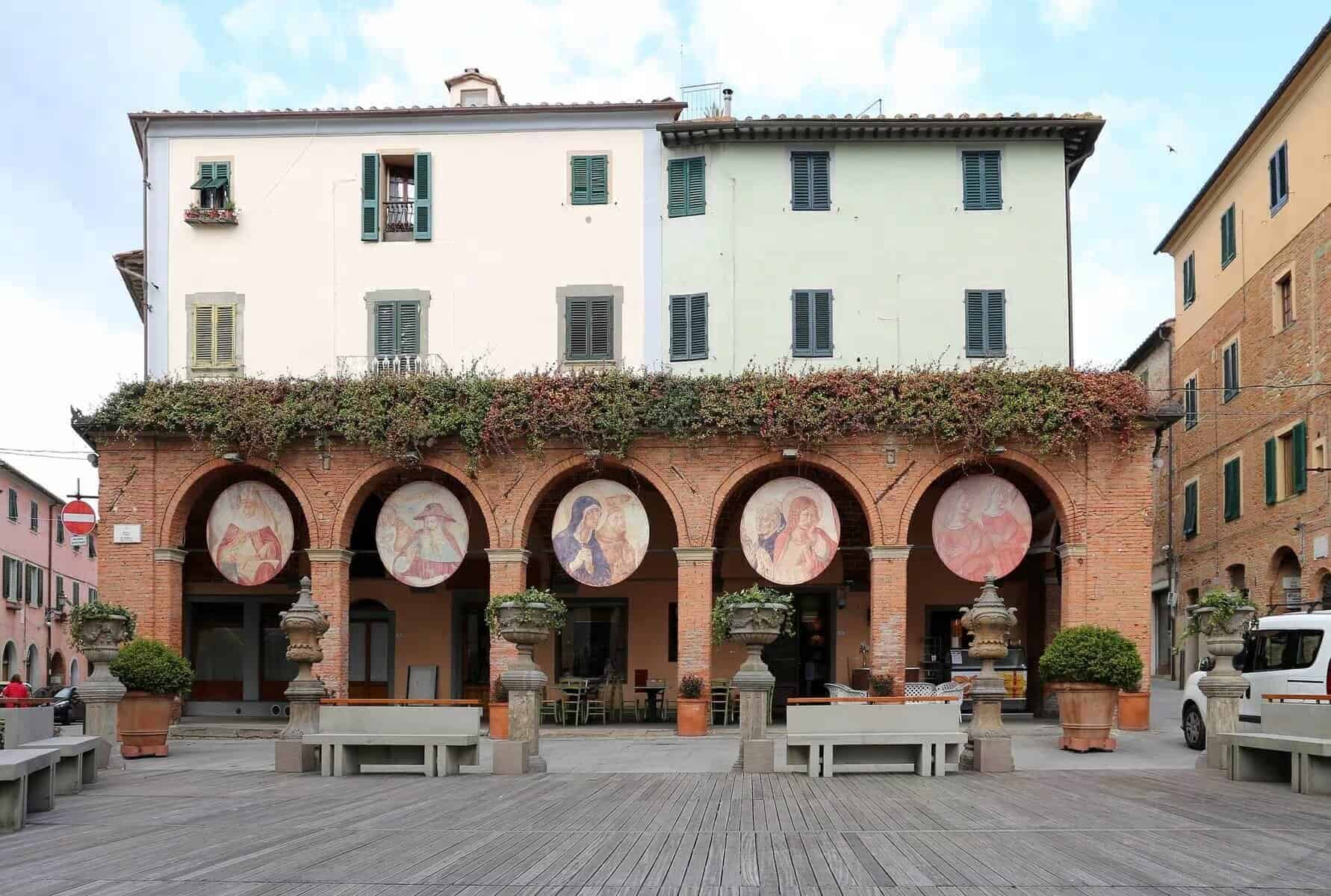
In 2024, a small municipality in the province of Pisa surpassed all competitors by winning the prestigious "Borgo dei Borghi" award. That municipality is Peccioli. This recognition was not a stroke of luck, but the culmination of a visionary path that began decades earlier, orchestrated by a mayor who embodies an often forgotten fundamental principle: administrative continuity .
The protagonist of this story isRenzo Macelloni , in his seventh term as mayor of Peccioli. With almost uninterrupted leadership since 1988, Macelloni has had the time and determination to implement a long-term strategy, now known throughout Italy as the “ Peccioli System ”. This is an integrated model that unites the Municipality with Belvedere SpA , a public-private company established in 1997 to manage the waste treatment plant in the Legoli hamlet. And here lies the first stroke of genius: transforming the management of a problem (waste) into an extraordinary source of wealth for the community. Over the years, Belvedere SpA has generated a direct economic impact of 174.7 million euros, a colossal sum that has been entirely reinvested in cultural projects, infrastructure and community services.
At the center of this permanent development strategy there is a cultural jewel: the “11Lune” festival , which will celebrate its 21st edition in 2025. Every July, the Fonte Mazzola Amphitheater becomes a stage of national and international fame. In twenty years, the festival has hosted 237 shows, attracting almost 270,000 spectators with artists of the caliber of Renzo Arbore, Gianna Nannini and Francesco De Gregori. The 2025 edition, with names such as Stefano Massini, Edoardo Leo, Umberto Tozzi and The Waterboys, confirms its trajectory of excellence.
But the real secret to defeating seasonality does not only lie in a prestigious summer event. It lies in having created resilient infrastructure capable of hosting events all year round, regardless of weather conditions. The Fonte Mazzola Amphitheatre, built in tuff without cement and inspired by ancient Greek theatres, is an excellent example of sustainable architecture. But it is the Green Triangle that represents the real revolution: an area that has transformed the Legoli landfill into a multifunctional cultural center, hosting concerts, fashion shows and events for the Maggio Fiorentino. This structure, equipped with covered spaces and advanced technology, allows Peccioli to maintain an active cultural calendar 365 days a year, completely neutralizing the risk of bad weather.
The Peccioli model teaches us that, while a summer event can attract tourists, it is the permanent infrastructure that keeps them coming back. It's the cultural ecosystem that makes them stay. They didn't just create a festival; they built a home for that festival and hundreds of other endeavors.
From the case study to the strategic principle (the lesson)
Peccioli's story is a practical demonstration of two powerful strategic principles that every local administrator should write in large letters on their office door.
The first, as we have seen, is that administrative continuity and a long-term vision are essential prerequisites for any significant territorial development. Profound transformations are not achieved in a single electoral five-year period. They require decades of coherent planning, progressive investment and community trust. The “Peccioli System” would never have existed without the political stability that allowed Renzo Macelloni to pursue his vision decade after decade.
The second principle, even more revolutionary, is that culture, when conceived as a permanent model and not as a sporadic event, becomes the primary driver of local development . Peccioli stopped thinking of culture as a series of disconnected events and began to build it as a permanent and widespread infrastructure.
What does this mean in practice? It means that the investment did not only go into the “11Lune” festival programme. It went into the creation of a complete ecosystem managed by the Peccioliper Foundation , which includes a Museum Center with three different locations, an Open Air Museum of Contemporary Art (MACCA) , libraries, archives and educational initiatives that take place all year round.
This approach radically transforms the nature of the tourist offer. A tourist no longer visits Peccioli just for the July show. Visit Peccioli at any time of the year to see the famous “Presenze” , the iconic sculptures up to 9 meters high by the Naturaliter group, which have become a symbol of the village. Two of them are even located at the waste treatment plant, turning a utility site into an artistic attraction. They visit Peccioli to admire works by international artists such as David Tremlett or Sergio Staino, who have transformed the urban fabric into a widespread museum.
This is the crucial point: Peccioli has moved from an "event-driven" logic to a "destination-driven" logic. The summer festival has become the flagship of a perennial cultural offering, not the only reason to visit. When culture becomes a stable infrastructure, the tourist flow naturally deseasonals, because the reasons for visiting the village do not disappear when the summer stage is dismantled. They remain, embedded in squares, buildings and even atop a hill of rubbish transformed into an amphitheatre.
Technology as an enabler (the indirect solution)
The principle of creating permanent cultural infrastructure is powerful, but its realization, as in the case of Peccioli, required decades and colossal investments. "That's great," you might think, "but I don't have 20 years or a multi-utility generating millions to reinvest. How can I apply this lesson today with my limited resources?"
This is where technology becomes the strategic accelerator , the great democratizer that allows even a small municipality to achieve similar results in much shorter times. To achieve deseasonalization, you need resilient infrastructure. But today, these infrastructures do not have to be permanent or built of concrete.
The problem of seasonality is, ultimately, a problem of vulnerability. Vulnerability to the weather: a downpour can undo months of work and tens of thousands of euros invested in an outdoor event. Vulnerability of spaces: Municipalities often have beautiful historic squares, perfect in summer, but lack indoor venues that are large, flexible and inspiring enough to host quality events in autumn or winter.
The solution lies in a new category of architecture: temporary, modular and technologically advanced structures that enable the creation of unique experiential spaces, 365 days a year, regardless of external conditions. I'm talking, for example, about immersive geodesic domes .
Think of a dome like our THOLUS DOME . It's not just a tent. It is a truly future-proof piece of architecture, combining iconic design with extraordinary technical performance. It is a “disaster-proof” structure, designed to withstand hurricane-force winds and heavy snow loads, which can be installed in record time (it takes just 135 minutes to assemble a 9-meter dome) in any location: a square, a park, even a brownfield.
Inside a dome, magic becomes possible. Thanks to 360-degree projection technology, you can transform it into a planetarium, an immersive cinema, a digital art gallery or an experimental theater. You can create a spectacular attraction that works at Christmas with snow, at Easter with rain and in August under the scorching sun. You can provide your community with a movie theater when the local one closed years ago. You can host conferences, workshops and corporate events. In essence, with a flexible investment, you create a multi-purpose cultural center that didn't exist before, just like Peccioli did with its Green Triangle, but in a fraction of the time and with a fraction of the budget.
This approach allows you to replicate Peccioli's strategy on a different scale. You're not just creating an event; you are equipping your municipality with a new, resilient cultural infrastructure, an attraction that can generate visitor flows throughout the year. You are creating the “place” where culture can shine, always.
This isn't just a theory; is supported by the data. Our comparative studies, also presented in the book “Immersive Events” , show that the ROI of a well-designed immersive experience hosted in a dedicated facility systematically exceeds 95% , compared to 23% for a traditional, one-off event. Why? Because the investment does not end with the event itself; creates a lasting asset that continues to generate value.
Technology, therefore, is not the end goal. It is the means that allows you to apply Peccioli's strategic principle – creating permanent culture – more quickly, flexibly and sustainably, transforming any public space into a potential magnet for tourism all year round .
Practical advice for local administrators (the action)
Peccioli's lesson is clear, but how can you transform it into concrete actions for your community, starting tomorrow morning? Here are three practical tips to bring to your next board meeting to start defeating the tyranny of seasonality.
- Think in terms of infrastructure, not seasons: radically rethink your approach to budgeting culture. Instead of dispersing resources into ten small summer events, vulnerable to the elements and with an ephemeral impact, focus your investments on the creation or renovation of a single high-quality cultural space, permanent or semi-permanent, that can operate 365 days a year. Whether renovating an existing building or installing a new structure, the goal is to create an “asset” that generates ongoing value, not a cost that ends with the final applause.
- Launch a Call for Resilience: identify an underused public space in your municipality – a square, a park, a former industrial site. Instead of the usual call for event proposals, launch a call for ideas for a light, innovative and resilient architectural installation, such as a geodesic dome, capable of hosting a multipurpose program (cinema, art, conferences) throughout the year. Consider a Special Public-Private Partnership (PPP) for its management, involving local operators. Don't just buy an event; invest in an “event venue”.
- Create your own “Giant of Peccioli”: deseasonalization feeds on permanent reasons to visit a place. Commission a work of public art that can become an icon, a recognizable symbol of your city. It doesn't have to be a colossal sculpture. It could be a permanent video mapping installation on the facade of the city hall, a sound trail in a park or a digital work of art. The goal is to create a contemporary landmark, an attraction that does not depend on a calendar but is always there, ready to welcome visitors and generate photos and word of mouth, even on a rainy Tuesday in November.
The vision
Peccioli's story gives us a truth as simple as it is revolutionary: seasonality is not an inevitable destiny written in the stars or in the weather forecast. It is the result of a strategic choice. You can suffer it passively, hoping for summer sun, or you can actively fight it by investing in vision, long-term planning and, above all, in permanent and resilient cultural infrastructure .
Today, this choice is no longer just an option for more sustainable tourism growth. In an era marked by climate change, where weather unpredictability has become the new, frightening normal, investing in cultural venues that operate 365 days a year is no longer just a development strategy. It is an act of responsibility. It is the only way to ensure a stable economic future for our communities, freeing them from the whims of a passing cloud.
“Tourism all year round” is not a utopia. It is a concrete development model based on the awareness that the greatest resource of a territory is not its climate, but its ability to generate beauty, meaning and memorable experiences. And, fortunately, these things have no season.
As “the usual neXt”, our mission is to provide courageous administrators with the technological and strategic tools to build this future. To create places where wonder does not depend on time.
Because the real infrastructure of the future is not just made of concrete and asphalt. It is made of culture, art and shared experiences. An iconic work of art, an innovative museum or a multifunctional cultural center are the only construction sites that, once completed, never stop working. Indeed: they begin to generate economic and social value, forever. And this is the most resilient infrastructure we can bequeath to future generations.