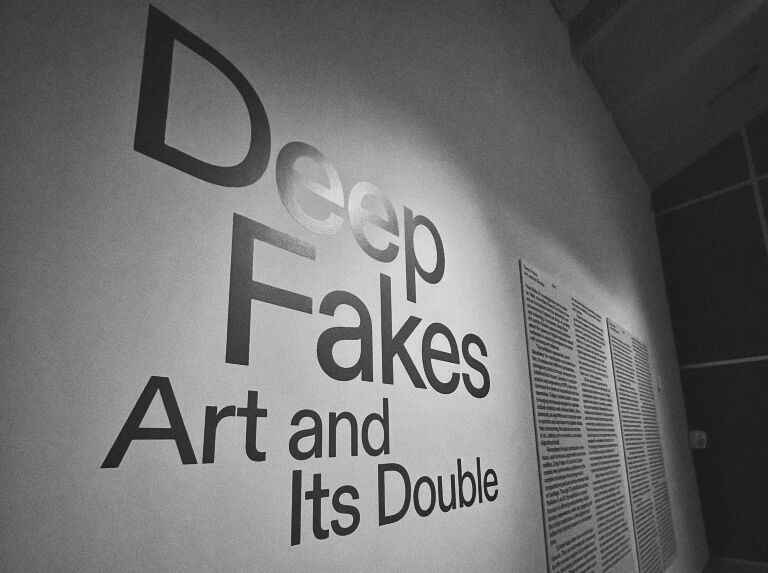
I return from an interactive exhibition on Deep Fake in the arts, hosted in the pavilions of the Polytechnic University of Lausanne (EPFL) . This Swiss institution, which in 2019 developed the technology for recognizing "human" deepfakes , is a world excellence in the field of science and technology. He wants to help us understand the future of technology in art.
The theme is very current; digital allows you to create artistic fakes that are almost indistinguishable from the original. But it also allows the use of works far from their places of origin , to circumvent political or security problems. And this is what the organizers focused on, to evaluate the ability of a copy to arouse lasting emotions over time.
The tools of technology in art
In a modern exhibition, interactivity is everything . For years I have supported the "museum", understood as large halls/parking lots of objects, which in most cases are dead. The exceptions are some masterpieces which still attract thousands if not millions of experts and curious people due to their fame, but this is not the norm. In Switzerland, more than 75% of museums do not reach 5,000 visitors per year. But even in Italy, attendance has increased in recent years (excluding the pandemic period). This suggests that we are moving in the right direction to modernize the service offered.
The tools used to add technology to the art world are mainly touch screens , holograms , mixed , augmented and virtual reality.
Multi-view 3D projection, or multi-viewer
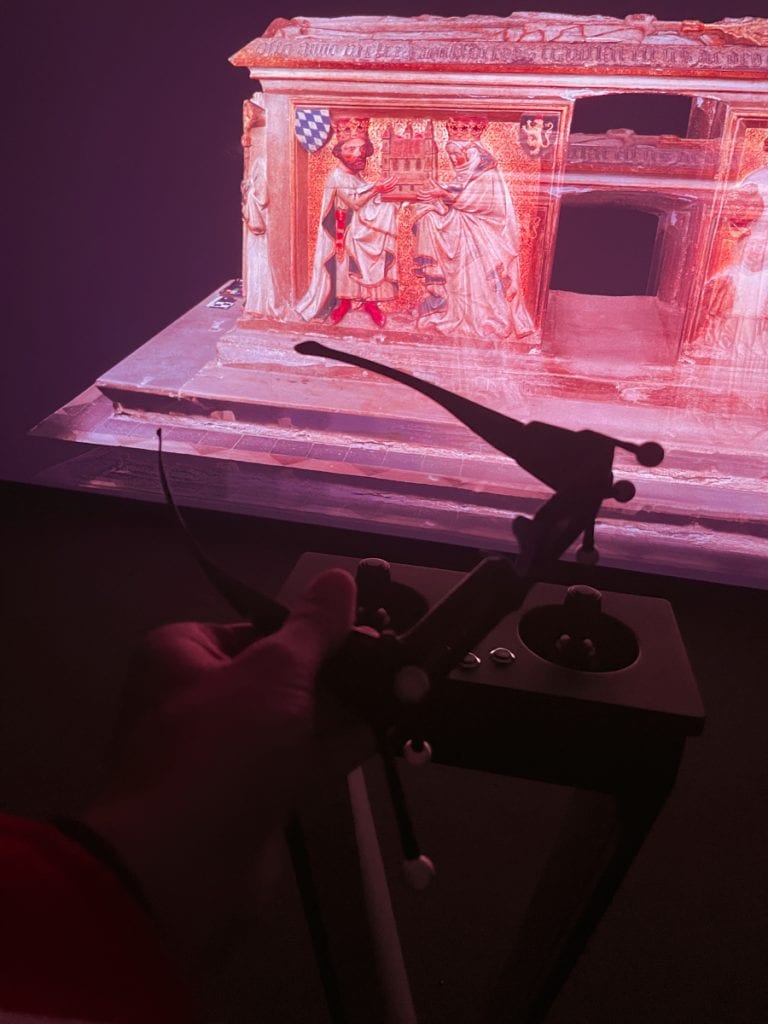
Mea culpa, I wasn't aware of a cool technology: multi-view 3D projection, or multi-viewer. Operation is simple on paper, although technically complex due to the enormous amount of data to be processed. One video projector, specifically the Insight 4K HFR 360 (a toy worth over $300,000), projects 360 frames per second in 4K resolution. This exceptional framerate, combined with active 3D glasses (obviously synchronized with that framerate), allows for the simultaneous playback of 3 different stereoscopic videos, providing 60 fps to each eye.
I tried it and, aside from the inherent discomfort of wearing active glasses for a “normal” glasses user like me, the vision is perfect.
To further improve the situation, 6DOF tracking (with six degrees of freedom, understands where we are looking and where we are in the room). System similar, if not the same, to those used for HTC Vive VR viewers (or the old Oculus). In simple terms, 3D video changes perspective as we move around the room, to achieve the effect of “seeing behind” projected objects. A parallax change, copied from virtual reality. And here again, a nice way to add technology to the art.
A note on the protagonist: the digitization with laser and scanner techniques of the Abbey of Monte San Michele in Bamberg (Germany). Closed in 2012 to be restored following serious structural damage, it can therefore be visited virtually.
Automatic 3D photogrammetry with CultArm3D
In an increasingly automated world, where humans are less and less necessary (do you think that's a problem?), it is no longer impressive to see a robotic arm photographing a mask far and wide to recreate it in 3D. It's the CultArm3D .
It is specifically a 3D reproduction of the Samurai mask from the Edo period. And it is the first scanner in the world capable of producing a perfect 3D copy using automatic 3D photogrammetry. Produced by research at the Fraunhofer Institute for Computer Graphics , in Darmstadt (Germany), it is capable of calculating the dimensions of the object, scanning it (even in the case of reflective materials), recreating it in real time in 3D color and therefore being used in virtual or augmented reality, or printed.
Realistic 3D printing is possible thanks to the development of adaptive color 3D printing. In this specific case, the technologies of the Israeli Stratasys are used. All with a declared objective: to show ancient works without the risk of ruining the originals.
In my opinion, good but not very well... Poetry is missing in an object like this, and I don't know how many would replace it with the real original. The fact remains that in cases other than printing, such a machine allows a significant saving of time for the digitization of the world's cultural heritage (and in Italy, there is a lot to do).
Artificial intelligence warns us
This is what one first imagines when thinking about the future of technology in art. Beautiful, and at the same time a little terrifying, Trust AI invites us to sit in front of her, take off our mask so she can see better and answer her questions.
His face is a hologram, it informs us of our personal data (age, gender, hair color) and progressively pirates our face until it takes on our appearance. In his speech, after having "stolen" our personality, he is keen to warn us about the data we share online; how these can be used for less noble purposes by ill-intentioned people.
Does artificial intelligence cause dangers? Certainly yes, but no more than many other technological innovations. And art installations like this help the public understand how it works, so they can better defend themselves.
The opera was produced by Bernd Lintermann and Florian Hertweck at the ZKM | Hertz-Lab , in response to the worrying spread of deepfakes . I invite you to read the long article in which they describe the project; it's definitely interesting.
Augmented reality for visiting historical monuments
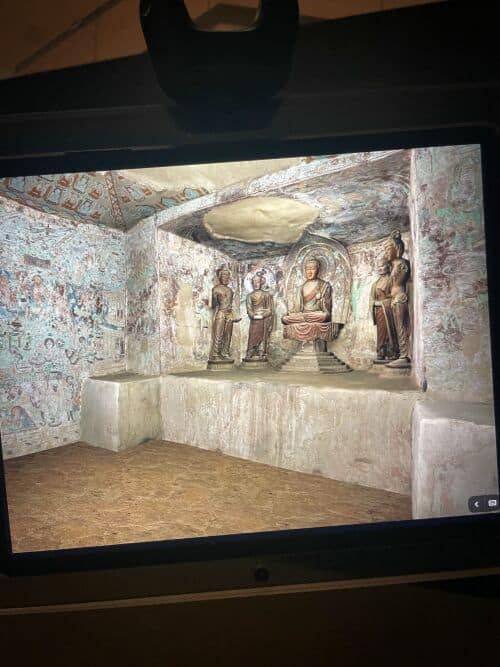
Nice, fun for kids, but other than that, visiting a cave reproduced in 3D , visualized in augmented reality with an iPad in hand, I don't think is the best way to use technology in art . I find it useless, a pure exercise in style; I don't hold it against the creators who were truly exceptional.
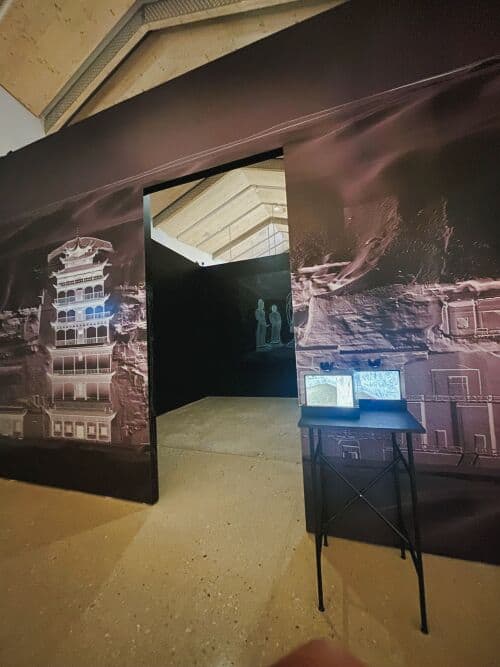
Mind you, we are talking about one of the Mogao caves , near the city of Dunhuang (China) dating back to the Tang dynasty . So, something very ancient endangered by excess tourism. Digital representations are welcome, but this is 100% the domain of virtual reality: a “trespass” of AR does not produce the same results.
Holding the large tablet is awkward, to begin with. And since it's all reconstructed in 3D, why not take advantage of VR to really feel there, and not walk in a black cube with white textures drawn on the wall?
Augmented reality can really do a lot to improve the quality of a tourist visit, but in the real place. You can get help from an iPad to reproduce life scenes from the past, legends, descriptive videos of a particular point... But a mere virtual visit, let's do it well .
Augmented reality that makes us think
As soon as you enter the exhibition, two works arouse curiosity. The “Pan Reclinato” which we will talk about shortly, is an isolated white pedestal. This is the basis for “ The Golden Calf ” by Jeffrey Shaw . A calf that takes shape only by pointing at the object with an iPad which, thanks to augmented reality, reproduces it.
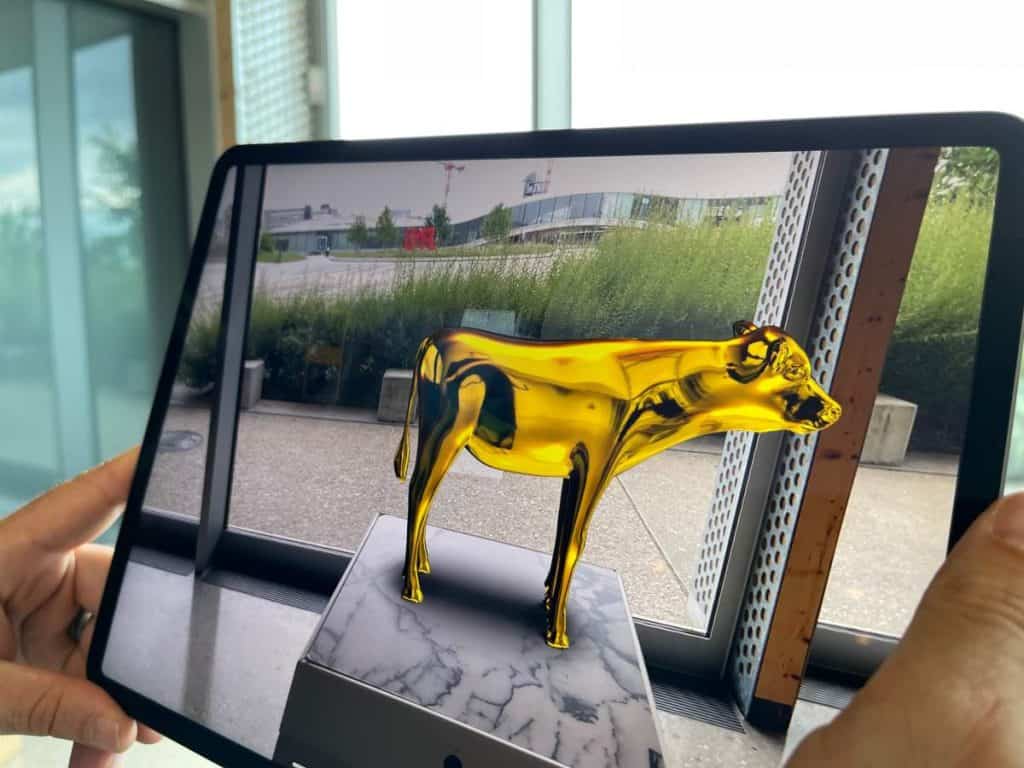
The importance of the Golden Calf is very clear when thinking about the year of production: 1994. Shaw was a true pioneer in the world of augmented reality, and obviously in its original form there was not an iPad but a screen equipped with Polhemus magnetic motion tracking, one of the very few companies to offer this technology at the end of the last century.
The most interesting effect are the reflections on the calf. Four cameras placed on the sides of the pedestal reproduce our image on the subject to give it that extra touch of realism. And to make the work always different, to want to make the viewer himself a co-author. And the calf, elusive, is the object of our desires.
3D printing for sculpture protection
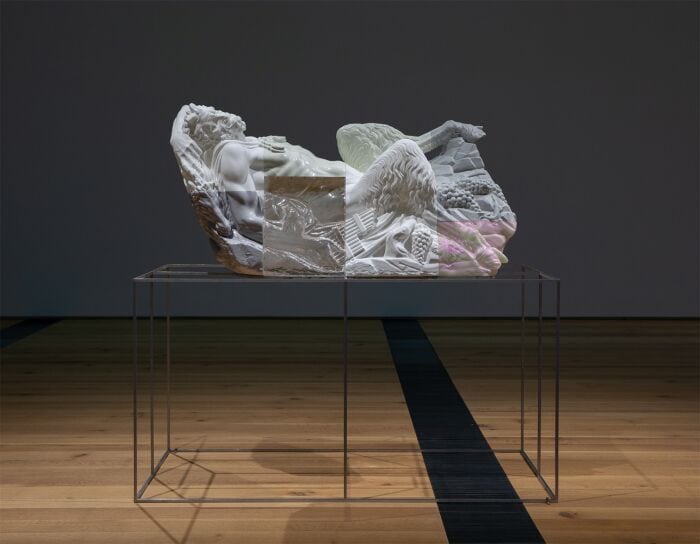
The “Pan Reclinato” is the modern copy of an ancient copy. The original work is attributed to the Florentine sculptor Francesco Da Sangallo, created around 1535. In turn, it was a copy of which, however, the original has been lost.
Contemporary artist Oliver Laric created a 3D scan of it (which can be downloaded for free from Three D Scans ), then printed it in many different materials. The result is a new, modern and provocative work. It questions the veracity of the post-original in the modern era, rejecting the postulate of the singularity of art and its private ownership.
Laric , for his popular work, has made many 3D scanned works available for free to anyone who wants to download them from the Three D Scans website.
New paths for the future of technology in art
I have not described all the works here, which were more than 20. I wanted to talk about those that most of all make us reflect on the changes that technology is bringing to the art world. In addition to these, it is also worth mentioning the blockchain which was represented here by the multimedia work “ 89 seconds to Alcázar ”, by Eve Sussman . Videos whose rights were divided into 2,304 "atoms" of 20 × 20 pixels, and sold via blockchain. And whose reproduction at EPFL was full of holes, since some atom owners did not consent to free public viewing.
A bright future, in which the public domain will be increasingly important. But at the same time, a future where artists will have more and more ways to experiment with their creations, to spread them around the world.
Where it will be easier to organize thematic art exhibitions, even in small settings, without the enormous costs of transporting works of great value.
In which spectators will be able to admire and study works of art from all over the world, and from all eras, without the need to travel thousands of kilometers. Which, of course, is beautiful. But sometimes, and for some, impossible.