the usual neXt Lab / Immersive Media Research
Publications
Independent research on immersive images, audiovisual perception and post-cinematic grammars. Each publication includes its abstract, metadata, citation and full text.
- Publication
- 02
- Full-text access
- Open
- Persistent identifier
- DOI
PDF · 11 pages · 223 KB
02 / 2026 System Paper / Preprint
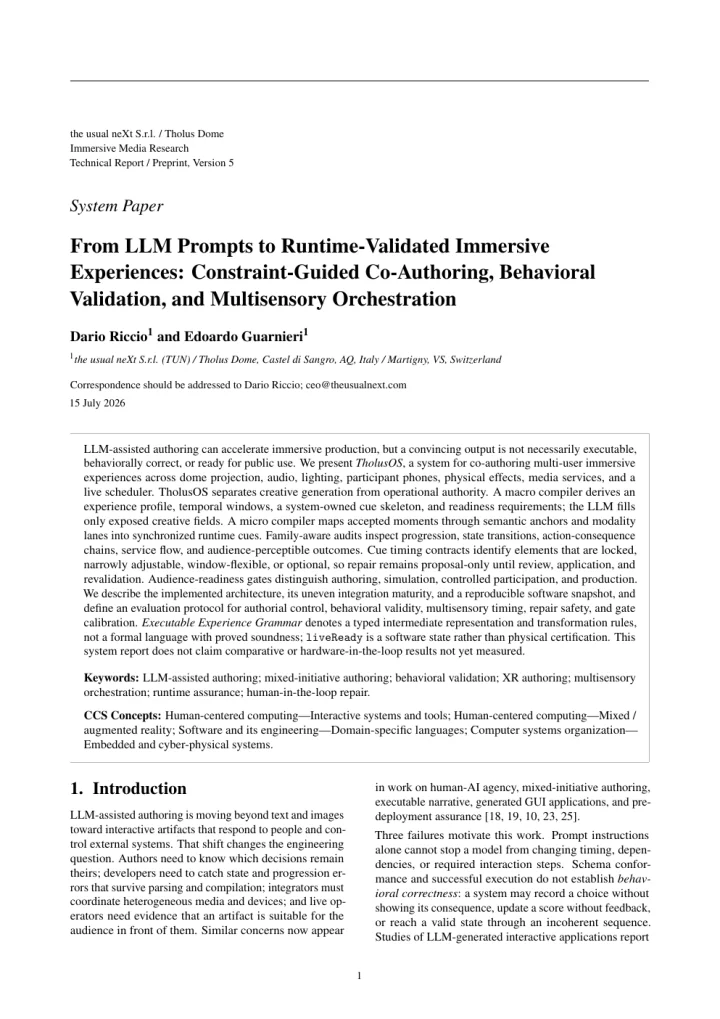
From LLM Prompts to Runtime-Validated Immersive Experiences: Constraint-Guided Co-Authoring, Behavioral Validation, and Multisensory Orchestration
The paper shows how TholusOS turns bounded LLM contributions into executable immersive experiences while validating progression, multisensory synchronization and audience readiness. More… Hide abstract
LLM-assisted authoring can accelerate immersive production, but a convincing output is not necessarily executable, behaviorally correct, or ready for public use. We present TholusOS, a system for co-authoring multi-user immersive experiences across dome projection, audio, lighting, participant phones, physical effects, media services, and a live scheduler. TholusOS separates creative generation from operational authority. A macro compiler derives an experience profile, temporal windows, a system-owned cue skeleton, and readiness requirements; the LLM fills only exposed creative fields. A micro compiler maps accepted moments through semantic anchors and modality lanes into synchronized runtime cues. Family-aware audits inspect progression, state transitions, action-consequence chains, service flow, and audience-perceptible outcomes. Cue timing contracts identify elements that are locked, narrowly adjustable, window-flexible, or optional, so repair remains proposal-only until review, application, and revalidation. Audience-readiness gates distinguish authoring, simulation, controlled participation, and production. We describe the implemented architecture, its uneven integration maturity, and a reproducible software snapshot, and define an evaluation protocol for authorial control, behavioral validity, multisensory timing, repair safety, and gate calibration. Executable Experience Grammar denotes a typed intermediate representation and transformation rules, not a formal language with proved soundness; liveReady is a software state rather than physical certification. This system report does not claim comparative or hardware-in-the-loop results not yet measured.
Full bibliographic record
Keywords
- LLM-assisted authoring
- mixed-initiative authoring
- behavioral validation
- XR authoring
- multisensory orchestration
- runtime assurance
- human-in-the-loop repair
How to cite
Riccio, D., & Guarnieri, E. (2026). From LLM Prompts to Runtime-Validated Immersive Experiences: Constraint-Guided Co-Authoring, Behavioral Validation, and Multisensory Orchestration (Version 5) [Technical report / preprint]. the usual neXt S.r.l. https://www.academia.edu/170244904/From_LLM_Prompts_to_Runtime_Validated_Immersive_Experiences_Constraint_Guided_Co_Authoring_Behavioral_Validation_and_Multisensory_Orchestration
BibTeX
@techreport{riccio_guarnieri_2026_tholusos,
  author = {Riccio, Dario and Guarnieri, Edoardo},
  title = {From LLM Prompts to Runtime-Validated Immersive Experiences: Constraint-Guided Co-Authoring, Behavioral Validation, and Multisensory Orchestration},
  institution = {the usual neXt S.r.l.},
  type = {Technical Report / Preprint},
  number = {Version 5},
  month = jul,
  year = {2026},
  url = {https://www.academia.edu/170244904/From_LLM_Prompts_to_Runtime_Validated_Immersive_Experiences_Constraint_Guided_Co_Authoring_Behavioral_Validation_and_Multisensory_Orchestration}
}
PDF · 7 pages · 36 KB
01 / 2026 Preprint
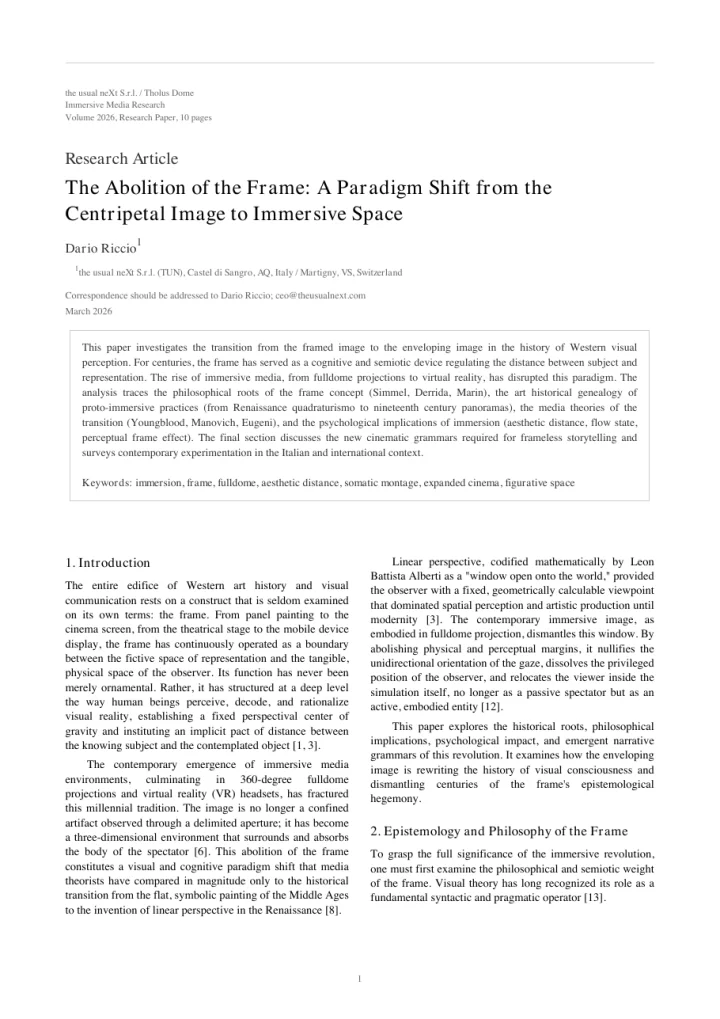
The Abolition of the Frame: A Paradigm Shift from the Centripetal Image to Immersive Space
The paper examines the shift from the framed image to immersive space through philosophy, perception and new audiovisual grammars. More… Hide abstract
This paper investigates the transition from the framed image to the enveloping image in the history of Western visual perception. For centuries, the frame has served as a cognitive and semiotic device regulating the distance between subject and representation. The rise of immersive media, from fulldome projections to virtual reality, has disrupted this paradigm. The analysis traces the philosophical roots of the frame concept (Simmel, Derrida, Marin), the art historical genealogy of proto-immersive practices (from Renaissance quadraturismo to nineteenth century panoramas), the media theories of the transition (Youngblood, Manovich, Eugeni), and the psychological implications of immersion (aesthetic distance, flow state, perceptual frame effect). The final section discusses the new cinematic grammars required for frameless storytelling and surveys contemporary experimentation in the Italian and international context.
Full bibliographic record
Keywords
- immersion
- frame
- fulldome
- aesthetic distance
- somatic montage
- expanded cinema
- figurative space
How to cite
Riccio, D. (2026). The Abolition of the Frame: A Paradigm Shift from the Centripetal Image to Immersive Space. Zenodo. https://doi.org/10.5281/zenodo.19160989
BibTeX
@misc{riccio_2026_19160989,
  author = {Riccio, Dario},
  title = {The Abolition of the Frame: A Paradigm Shift from the Centripetal Image to Immersive Space},
  month = mar,
  year = {2026},
  publisher = {Zenodo},
  doi = {10.5281/zenodo.19160989},
  url = {https://doi.org/10.5281/zenodo.19160989}
}