Imagine walking through a space where each step unleashes cascades of colored light. Plus, rainforest scents envelop you as the floor vibrates beneath your feet. However, this is not science fiction: in fact, it is multisensory art in its purest form.
So, welcome to a dimension where experience transcends mere observation. Therefore, this art form becomes a bridge between technology and humanity, creating profound connections. Consequently, each sense actively participates in contemporary artistic narration. Likewise, this revolution completely redefines our relationship with cultural space.
The in-depth information in this article is taken from the book “Immersive Events” by Dario Riccio, a complete guide on the transformation of the human experience through immersive technologies.
The Symphony of the Five Senses in Multisensory Art: How to Transform Human Perception
Sight: The First Impact of Multisensory Art
Sight traditionally represents the main channel through which we enter the artistic experience. However, in immersive experiences, it only becomes the beginning of a more complex journey. Thus, modern technologies offer extraordinary possibilities to amplify this first sensory contact.
Furthermore, the dynamic lights react instantly to the audience's movements, creating interactive visual dialogues. Therefore, architectural projections transform building facades into living canvases that tell stories. As a result, multisensory art also uses holograms that magically float in the air, challenging habitual perception.
Subsequently, the art installations play with shapes and colors in completely unexpected ways. Indeed, these visual creations set the stage for the full experience, inviting the other senses to actively participate.
Hearing: Soundscapes in Multisensory Art
Hearing immediately follows sight, creating acoustic landscapes that instantly transport us elsewhere. Therefore, artfully designed soundtracks combine with ambient effects in multisensory art . Thus, we can be psychologically geolocated in a rainforest or futuristic metropolis.
Furthermore, spatialized audio technologies make the sounds around us literally dance. As a result, we are enveloped in a three-dimensional sound bubble that amplifies the total immersive experience. Likewise, these acoustic landscapes create immediate and lasting emotional connections.
Therefore, sound design becomes a fundamental narrative element, not simply musical accompaniment. In fact, in the complete experience, each frequency contributes to the construction of the overall atmosphere of the artistic installation.
Smell: Ancestral Memory in Multisensory Experiences
However, the real magic of immersive experiences begins when you engage your other senses. In fact, the sense of smell represents the most ancestral and powerful in recalling deep memories and emotions. Therefore, it can be strategically stimulated with fragrances diffused in the surrounding environment of multisensory art .
Furthermore, the characteristic smell of rain perfectly accompanies a simulated storm in interactive installations. Subsequently, the intoxicating scent of oriental spices recreates the atmosphere of authentic exotic markets. Likewise, delicate floral notes accompany spring scenes, amplifying complete sensory immersion.
As a result, neuroscience shows that odors directly reach the brain's limbic system. Therefore, the seat of emotions and memory, smell creates immediate connections in the artistic experience. Thus, these connections are particularly long-lasting and significant for the overall involvement of the visitor.
Touch: Physical Anchoring in Multisensory Art
Touch comes into play through the materiality of the installations in contemporary multisensorial art . In fact, it creates a fundamental bridge between the virtual world and the completely real one. Therefore, the roughness of a simulated rock face offers authentic and immersive tactile sensations.
Furthermore, the unexpected softness of hidden fabrics surprises and delights visitors to the immersive experience. Subsequently, the vibration of the floor underfoot responds dynamically to individual movements. As a result, installations explicitly invite physical contact, breaking traditional barriers of contemplative art.
Therefore, these tactile elements are not merely decorative but essential in the complete sensory experience. Therefore, they anchor the virtual experience to the concrete physicality of the human body, creating perceptual authenticity.
Taste: The Completion of Multisensory Installations
Finally, taste completes the sensory equation through thematic culinary experiences in multisensory art . Furthermore, cocktails change color or flavor during the event, surprising the participants of the installation. Subsequently, foods are presented in ways that completely challenge the public's usual perception.
Therefore, this complete sensorial symphony radically transforms the nature of every artistic event. As a result, the immersive experience creates a complete orchestra that involves the entire human body. Thus, each sense contributes to the overall narrative in a harmonious and perfectly coordinated way.
The Science of Multisensory Art: Flow in Total Experience
The effectiveness of multisensory art is not accidental but has roots in contemporary human psychology. In fact, the concept of “flow” described by Mihály Csíkszentmihályi defines the optimal state of concentration. Therefore, it is characterized by total concentration and loss of awareness of time passing.
Furthermore, recent studies reveal fascinating data: the brain handles approximately 110 bits of information per second. However, a normal conversation requires only 40-60 bits, taking up a third of the brain's capacity. Therefore, during a well-designed immersive experience, all perceptual capacity is engaged simultaneously.
As a result, it becomes almost impossible to focus on external concerns or habitual time perception. Subsequently, in Italy, pioneering studies by Fausto Massimini and Antonella Delle Fave of the University of Milan explored this state. Therefore, they confirm that multisensory art can indeed induce optimal flow of consciousness.
Thus, as highlighted in studies on the benefits of immersive events , these experiences completely capture the attention and cognitive resources available in the individual.
Examples of Multisensory Art: International and National Case Studies of Excellence
International Pioneers of Multisensory Experiences
The Sense Gallery in Switzerland has created the first reality with six completely multi-sensory rooms. Furthermore, plays of light and optical illusions transform the visitor into the absolute protagonist of the experience. Thus, multisensory art overcomes the boundaries of ordinary reality through innovative and engaging interactive installations.
Subsequently, in Paris, the Atelier des Lumières pioneered the transformation of a historic former industrial foundry. Therefore, it has become an immersive digital art center where masterpieces are literally "worn" by the public. As a result, visitors experience monumental projections that completely cover every surface of their surroundings.
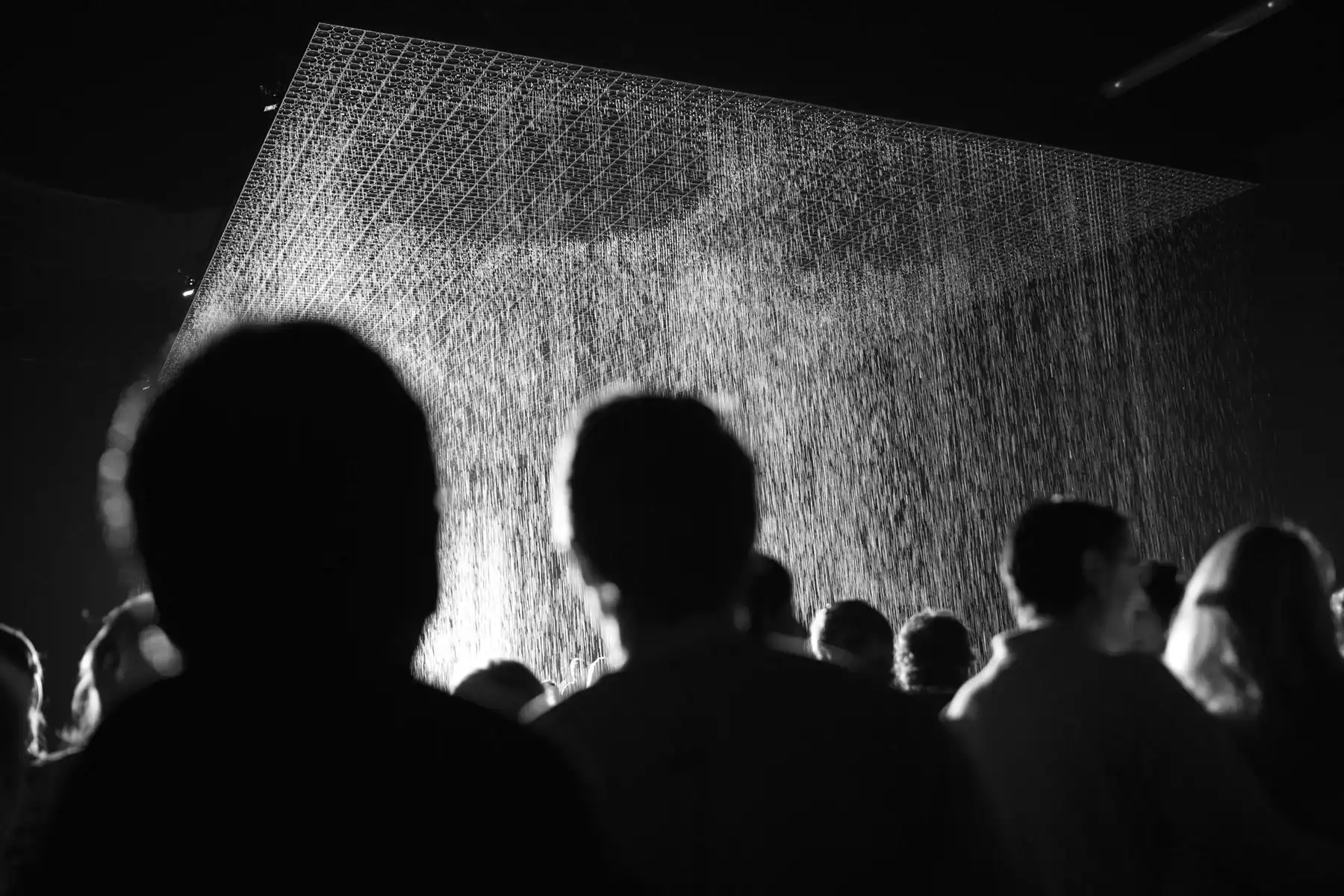
Furthermore, the “Rain Room” installation by Random International is particularly poetic: perpetual and engaging rain. However, it magically stops where a human body is detected in multisensory art . Thus, it offers a unique sensorial experience within a reactive relationship between technology and physical presence.
Italian Experiences of Multisensory Art
The Cinema Teatro Duomo of Rovigo recently curated "Beyond sight. Experiences for the five senses". In fact, this innovative event dedicated each event to a specific sense of human experience. So, from gin tasting for taste to exploring coffee aromas for sensorial smell.
Furthermore, evenings dedicated to touch with cosmetics experts completed the offer of Italian multisensory art . Therefore, this approach demonstrates how immersion can be designed methodically, sense by sense. As a result, a layered and fully immersive experience is created for all participants.
Subsequently, many Italian institutions are adopting similar principles in contemporary artistic innovation. Therefore, a new awareness of the comprehensive sensory potential in cultural spaces is spreading.
From the Artifact to Multisensory Art: The Contemporary Artistic Revolution
This brings us to a fundamental change in conceiving contemporary art and entertainment. In fact, we are witnessing the transition from the traditional artefact to the immersive experience of multisensory art . So, for centuries, art has predominantly been an object to be contemplated passively from a distance.
However, immersive experiences dissolve this separation between observer and traditional artwork. Therefore, the work is no longer just the physical object, but the entire environment created specifically for it. Consequently, art becomes a relational space that is experienced from the inside, not passively contemplated from the outside.
Furthermore, as the Futurists already hoped for by placing "the spectator in the center of the picture", multisensory art realizes this vision. Subsequently, Lucio Fontana wanted to break art out of its traditional and limiting framework. Thus, today we become co-creators of the artistic experience itself, actively participating in its realization.
In the same way, today we talk about phygital art in immersive experiences: hybrid between physical and digital. Therefore, technology is not the protagonist but an invisible tool at the service of authentic human emotion.
Multisensory Technologies: When Technique Disappears into Experience
Interestingly, the most powerful immersive experiences use completely invisible technology. Indeed, the British company Punchdrunk , pioneers of immersive theatre, uses sophisticated and advanced lighting. Furthermore, elaborate sound design and detailed sets characterize “Sleep No More”, rarely digital technologies evident.
However, the show transforms five floors of the building into a narrative labyrinth in multisensory art . Then, viewers, wearing white masks, freely explore intersecting and deeply engaging stories. Therefore, as explored in the analysis of contemporary immersive theatre , the audience becomes the absolute protagonist of the stage action.
Accordingly, French sensorial designer Germain Bourré says: “Technology should be like oxygen.” Subsequently, he explains that in immersive experiences it should be “essential but invisible, allowing the experience without imposing itself as the protagonist”.
Interactivity in Multisensory Art: The Audience as the Protagonist of the Experience
Interactivity represents one of the distinctive features of contemporary and innovative multisensory art . In fact, we are no longer simple passive spectators, but we become active actors of the experience. Therefore, this participation is made possible by increasingly sophisticated and accessible technological systems.
Furthermore, PIR and ultrasonic motion sensors detect the presence and movements of the participating public. Therefore, they transform them into inputs that dynamically change the environment of the art installation in real time. Next, Raspberry Pi camera modules enable economical and precise face tracking and motion detection.
As a result, touch surfaces, object recognition systems and environmental sensors create complex interactive ecosystems. Thus, wearable devices in multisensory art dynamically respond to human presence in real time and continuously.
Interactive Floors in Multisensory Installations
Interactive floors represent a particularly fascinating frontier of contemporary artistic installations. In fact, ordinary surfaces are transformed into dynamic installations that react instantly to footsteps. Then, they create waves of light, sound or visual effects that faithfully follow the movements.
Furthermore, this technology in multisensory art transforms simple walking into a creative and meaningful act. Therefore, each step becomes a brushstroke on a digital canvas that responds instantly to contact. As a result, a continuous dialogue is created between the body and the surrounding, responsive artistic space.
The Future of Multisensory Art: Towards New Sensory Frontiers
The revolution of multisensory art is not just a technological question but represents a new innovative way. In fact, to conceive the human experience in contemporary and future public and private spaces. Thus, neuroscience continues to reveal to us how perception is intrinsically multisensory and complex.
Furthermore, our senses constantly influence each other in the "cross-modal processing" of advanced immersive experiences. Therefore, adding the smell of damp wood to forestry installation is not simply aesthetic embellishment. Subsequently, it is an element that can exponentially increase the perception of realism in the overall sensory experience.
As a result, tactile surfaces and vibrations anchor the virtual experience to concrete bodily physicality. Thus, they create a bridge between digital and real that strengthens the sense of presence in multisensory art .
Educational Applications of Multisensory Art
As highlighted in studies on how immersion revolutionizes education , sensory experiences find extraordinary applications in the educational field. In fact, students can literally walk through historical events or explore interactive three-dimensional molecules.
Furthermore, this approach in multisensory art significantly improves retention and understanding of complex educational content. Therefore, learning becomes an engaging experience that stimulates all perceptual channels simultaneously and effectively. Therefore, stronger and longer-lasting neural connections are created in long-term memory.
Conclusions: The Bridge to the Future of Human Experience
Multisensory art is redefining the boundaries between art, technology and contemporary and innovative public space. Indeed, it creates new forms of storytelling and engagement that speak directly to our deepest being. So, in an increasingly digital and fragmented world, this revolution brings us back to the human essential.
However, it is not about nostalgia but about conscious evolution: this art form represents the future. Therefore, each sense becomes known in the orchestra of human experience, creating harmonies that were previously completely unthinkable. As a result, body, mind and emotions finally find themselves in perfect harmony and balance.
Furthermore, the future of art, entertainment and communication inevitably passes through this sensorial dimension. After that, immersive experiences will continue to evolve, offering ever more extraordinary and engaging possibilities. Thus, we prepare for a tomorrow where the human experience will be completely transformed and infinitely enriched.
To further explore these themes and discover how to implement immersive projects, we recommend reading "Immersive Events" by Dario Riccio, available on Amazon.